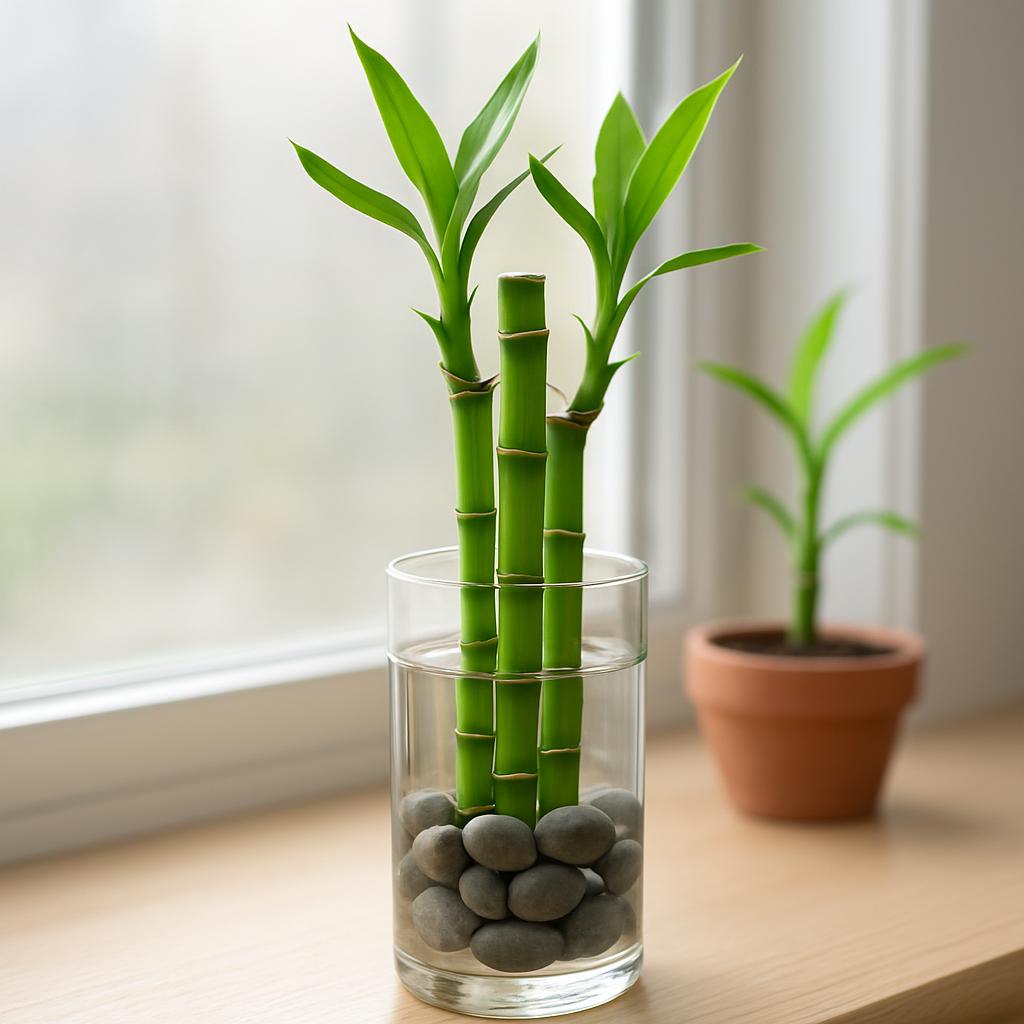
Lucky bamboo care comes down to three things: bright, indirect light, clean water (or evenly moist soil), and very little fertilizer. The plant is Dracaena sanderiana, a tropical African foliage plant that only resembles bamboo, and it does well in a vase of pebbles or a pot of potting mix. This guide covers both setups, the usual cause of yellow stalks, what the stalk counts mean in feng shui, and how to start new plants from cuttings.
Key takeaways
- Lucky bamboo is a dracaena, not a bamboo, so treat it like a tropical houseplant rather than a grass.
- In water, cover the roots, change the water weekly, and use filtered, distilled or rainwater if your tap water is treated.
- Bright, indirect light is best; direct sun scorches the leaves, and dim light only slows growth.
- Yellow stalks usually trace to water chemistry, overfeeding, rot or sun, and a stalk that is fully yellow will not turn green again.
- Stalk counts carry feng shui meanings, with three, six and eight favored and four traditionally avoided, but sources disagree on some numbers.
Is lucky bamboo actually bamboo?
No. Lucky bamboo is Dracaena sanderiana, a member of the asparagus family, and it is unrelated to the grasses that make up true bamboo. NC State Extension's plant database says flatly that it is not a bamboo at all, and describes a thick, fleshy green stem that only resembles bamboo canes.
The Missouri Botanical Garden lists it as a slow-growing herbaceous perennial native to tropical western Africa that can reach about 5 feet tall. The jointed look comes from distinct nodes along the stem. That origin explains most of its care: it evolved in warm, shaded, humid forest, which is why bright sun burns it and cold drafts hurt it.
Other names on garden-center tags include ribbon dracaena, Belgian evergreen, friendship bamboo and Chinese water bamboo. They all describe the same plant. The curly spiral stalks sold as novelties are ordinary canes that growers turn toward a light source as they grow, and the braided "towers" are several canes woven together.
Because it is a dracaena, it is also a pet hazard. NC State tags the plant as a problem for dogs and cats, and it is poisonous if eaten, so keep it where pets and small children cannot chew the leaves or knock over the vase.
How do you grow lucky bamboo in water with stones?
Set the canes in a clean container, hold them upright with pebbles, and keep the water above the roots. The Missouri Botanical Garden notes the plant can grow in water as long as the roots have a substrate such as pebbles to anchor in, and Clemson Cooperative Extension says the water should cover the roots and at least one inch of the stem.
The stones are not decoration only. They keep top-heavy canes from tipping and give the roots something to grip. Smooth river stones, aquarium gravel, marbles and glass beads all work, provided they are washed first. Avoid anything that leaches minerals or dye, such as some painted or limestone-heavy decorative gravel.
A container with a solid base, a few inches deep, suits most arrangements. Clear glass looks good but lets light reach the water, which feeds algae, so an opaque or tinted vase is easier to keep clean.
Setting up a water vase, step by step
- Wash the vase and stones with hot water and rinse them well.
- Add a 1- to 2-inch layer of stones to the bottom.
- Stand the canes in the stones so the roots spread among them. If a cane has no roots yet, make sure the cut base is submerged.
- Add water to cover the roots and at least an inch of stem, keeping the leaves dry.
- Place the vase in bright, indirect light, away from heating vents and cold windows.
- Top up between changes with the same kind of water you plan to use for the full change.
Orange or reddish roots are normal in water-grown plants. Roots that are brown, mushy or foul-smelling are not, and the water should be changed at once with any dead tissue trimmed away using clean scissors.
What water is best, and how often should you change it?
Use filtered, distilled or rainwater, and change it every week. Clemson's guidance is weekly, and some growers stretch to every 7 to 10 days. Lucky bamboo is sensitive to chlorine and fluoride, and the symptoms show up as yellow or brown leaf tips.
Letting tap water stand overnight lets chlorine escape, but it does not remove fluoride. If your town fluoridates its water, or your water is hard, distilled water is the safer choice. Chloramine, which some utilities use in place of chlorine, also does not simply evaporate. Water at room temperature is gentler on the roots than cold water straight from the tap.
| Water source | Works? | Notes |
|---|---|---|
| Distilled | Best | No minerals, chlorine or fluoride |
| Rainwater | Good | Collect from a clean container, not a roof gutter with debris |
| Filtered (pitcher) | Good | Reduces chlorine; may not remove all fluoride |
| Tap, left out 24 hours | Marginal | Chlorine escapes; fluoride and salts stay |
| Softened water | Avoid | Added salts build up in the stalks |
How do you keep algae out of the vase?
Cut off the light that reaches the water and replace the water on schedule. Algae needs light, warmth and nutrients, and a clear vase on a bright sill with fertilizer in the water supplies all three.
At each water change, lift the canes out, rinse the roots under lukewarm water, and scrub the container and stones with hot water and a little dish soap. Rinse until no soap remains. Slimy film on the stones means they need scrubbing, and a sour smell means the water sat too long.
If algae keeps returning, switch to an opaque vase, move the plant a little farther from the window, and use less fertilizer. Algae is mostly a nuisance, but the same stagnant conditions can rot the base of the canes, which is a real problem.
How do you grow lucky bamboo in soil?
Plant it in a well-drained potting mix and keep the mix evenly moist, never soggy. Clemson recommends well-drained potting soil, and the Missouri Botanical Garden describes the plant as easily grown in evenly moist soil.
Choose a pot with drainage holes. Bury the cane bases a few inches deep, firm the mix around them, and water until it runs from the bottom. Water again when the top inch of mix feels dry. In a dim room that may mean every week or two, and less in winter.
Soil-grown plants are generally sturdier than those in water, and they hold more nutrients, so they need less frequent feeding. They also tolerate tap water somewhat better because the potting mix buffers some of the minerals, though leaf-tip browning can still appear over months. Flush the pot with distilled or rainwater now and then if you see it.
A plant sold in water can be moved to soil, and the reverse is harder. Roots grown in water are adapted to it and often die back when potted, so expect some leaf loss and keep the mix moist for the first few weeks. Switching from soil to water works best by rooting a fresh cutting.
How much light, warmth and fertilizer does it need?
Give it bright, indirect light, steady room temperatures and a very light feeding schedule. Clemson suggests east- or north-facing rooms and warns that direct sunlight damages the leaves. The Missouri Botanical Garden agrees that too much direct sun scorches the foliage.
Lucky bamboo tolerates low light, but growth slows and the plant stretches. A bright spot a few feet from a window beats a dim corner. Rotate the vase occasionally so the canes do not lean. Keep it in a warm room, roughly 65 to 80°F, and away from cold glass, air conditioners and heaters. It is only hardy outdoors in frost-free zones, which Clemson puts at zones 10 to 12.
For feeding, Clemson says to fertilize water-grown plants every other month with liquid houseplant fertilizer at one-quarter of the recommended rate. A product labeled for lucky bamboo or dracaena is easiest to dose, usually a drop or two. Skip fertilizer entirely if the plant is growing slowly but staying green. Without feeding it will survive for years, and overfeeding causes more damage than hunger does.
- Light: bright and indirect, no hot midday sun on the leaves
- Temperature: normal room warmth, no cold drafts
- Fertilizer: quarter strength, every other month at most
- Humidity: average; very dry air browns leaf tips
Why are lucky bamboo stalks turning yellow?
Yellow stalks usually come from water chemistry, overfeeding, too much sun, or rot. Look at where the yellow starts before changing anything, because each cause leaves a different pattern. One firm rule applies to all of them: a stalk that has turned fully yellow will not turn green again.
| What you see | Likely cause | Fix |
|---|---|---|
| Yellow leaf tips or leaves on a green stalk | Chlorine, fluoride or salts in water; too much fertilizer | Switch to distilled or filtered water; stop feeding for a few months |
| Pale, scorched or bleached leaves | Direct sun | Move to bright indirect light |
| Stalk yellowing from the base, soft or smelly | Rot from stagnant water or overwatered soil | Cut out affected canes, clean the vase, refresh the water |
| Whole stalk yellow and wrinkled | Advanced rot or age | Remove it to protect the other canes |
Rot needs fast action. NC State notes that overwatering can yellow leaves and rot the stems. Pull the plant out and look: healthy canes are firm and green. Cut off any that are yellow and mushy, and trim a cane that is only yellow at the top below the damage with a clean knife, then root it again in fresh water. Even a cut section with a healthy node can often start over.
Pests are less common indoors. NC State lists mealybugs, thrips and false spider mites among the pests that can affect the plant. Wipe leaves with a damp cloth and, if needed, use insecticidal soap.
What do the number of stalks mean in feng shui?
In feng shui tradition, each stalk count carries a different wish, with eight often called the luckiest and four avoided. The counts rest largely on wordplay in Chinese: eight sounds like the word for prosperity, and four sounds like the word for death. Some sellers also note that six sounds like "flowing," suggesting that luck arrives smoothly.
The meanings below follow the list in The Old Farmer's Almanac. Other sources assign some numbers differently. Five, for instance, is variously tied to health, balance or wealth, so treat this as folklore rather than a fixed code.
| Stalks | Traditional meaning |
|---|---|
| 2 | Love or double luck |
| 3 | Happiness, long life and wealth |
| 4 | Avoided; bad luck |
| 5 | Balance in the five areas of health |
| 6 | Prosperity and wealth |
| 7 | Good health |
| 8 | Success, growth and fertility |
| 9 | Great luck |
| 10 | A complete, perfect life |
| 21 | Great wealth and enduring health |
Placement lore is just as loose. The southeast corner is commonly cited as the wealth sector, and a red ribbon tied around the stalks is said to add energy and protection. The plant's growth in water ties it to the water element. None of this has horticultural effect, but a healthy, tidy plant in a bright spot does make a pleasant gift, which is why stalk counts matter to buyers.
If you receive four stalks and the tradition matters to you, the usual workaround is to add or remove one so the count changes. Readers interested in other plants with symbolic meaning can compare the yucca plant's meaning and history or the shamrock plant, another houseplant traditionally given for luck.
How do you propagate lucky bamboo?
Take a stem cutting that includes a node and root it in clean water. Lucky bamboo is grown commercially from cuttings, since it rarely flowers indoors, and extension sources note that dracaenas can be propagated by stem cuttings.
- Choose a healthy, firm cane with visible nodes, the slightly raised rings along the stem.
- Using clean, sharp pruners or a knife, cut the cane about an inch below a node. The cutting should have at least one node and, ideally, a few leaves.
- Stand the cutting in a few inches of distilled or filtered water, with the cut end submerged and any leaves above the surface.
- Keep it in bright, indirect light and change the water weekly.
- Roots usually appear within several weeks. Once they are an inch or two long, move the cutting into a vase with pebbles or pot it in moist, well-drained soil.
The parent plant is not wasted by the cut. Leaf buds below the cut can sprout, and the Missouri Botanical Garden suggests cutting older, lanky stems back to the base to encourage fresh growth. Some growers seal the cut end of the parent cane with a dab of candle wax to reduce moisture loss and rot, although it is optional.
Expect slow progress. New shoots grow from the nodes at an unhurried pace, and a cutting kept in dim light may sit for weeks before it roots. Patience and clean water do more than any rooting additive.
Frequently asked questions
Is lucky bamboo safe for cats and dogs?
No. NC State's plant database tags it as a problem for dogs and cats, and it is poisonous if eaten. Chewing the leaves or stalks can cause drooling, vomiting and loss of appetite, so keep it out of reach and call your vet or an animal poison hotline if a pet eats any.
Can lucky bamboo live in water forever?
It can survive in water for years with weekly water changes, clean water and occasional dilute feeding. Eventually, canes may outgrow the vase or decline, and moving the plant to soil or rooting fresh cuttings renews it.
Can I use tap water for lucky bamboo?
Sometimes, but it is a common cause of leaf-tip browning. Standing the water overnight removes chlorine only, not fluoride or salts. Distilled, filtered or rainwater is the safer choice.
Why is my lucky bamboo not growing?
It is a slow grower even in good conditions, and dim light slows it further. Move it to brighter indirect light, make sure the water is fresh, and feed very lightly. Healthy green canes that are not growing are not in trouble.
Can I trim a lucky bamboo that has gotten too tall?
Yes. Cut the cane just above a node, and the node below the cut will usually sprout new growth. The cut-off top can be rooted in water as a new plant.
Does lucky bamboo need to be fertilized?
Not much. Clemson suggests feeding water-grown plants every other month at quarter strength, and a plant in clean water can go longer without. Too much fertilizer yellows the leaves and feeds algae.