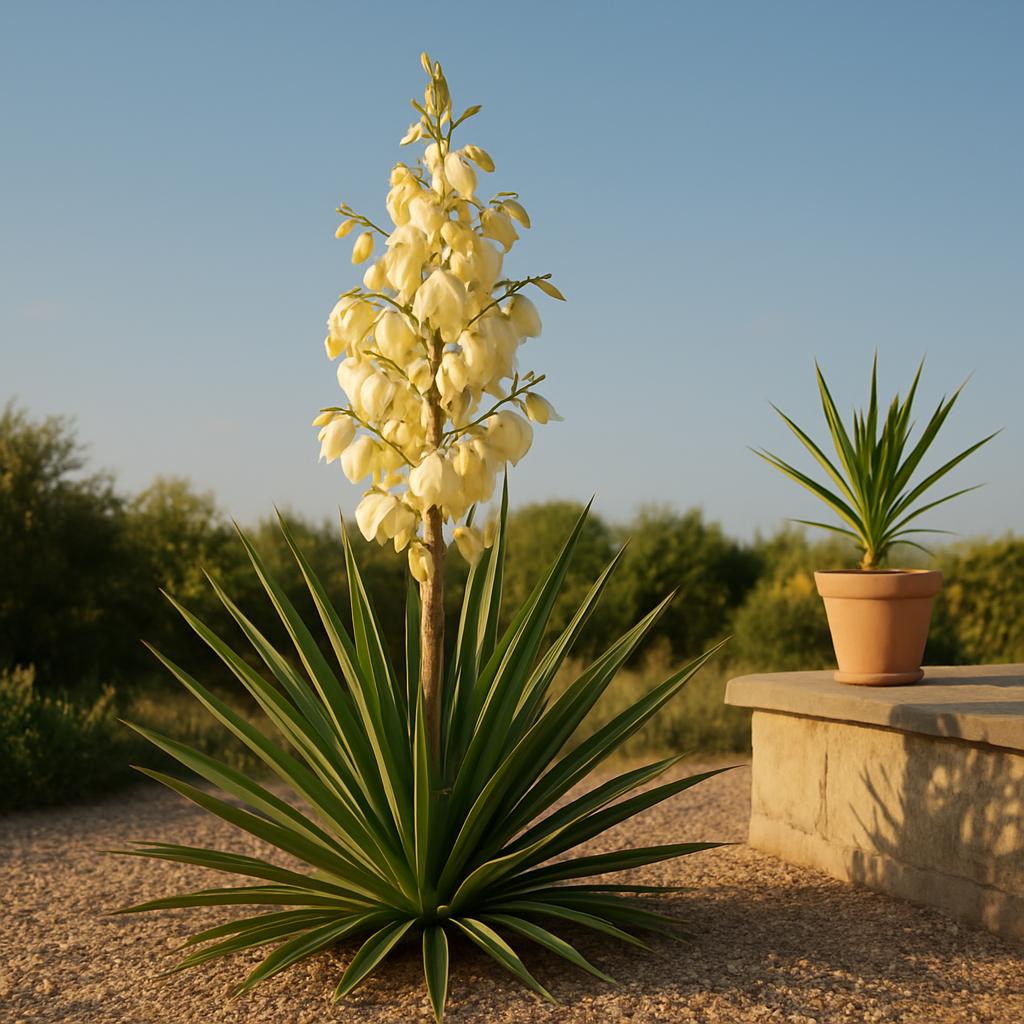
Yucca plant meaning centers on endurance, protection and purity, traits people read into a spiky evergreen that survives drought, cold snaps and neglect, then sends up a tall spire of white bells. The symbolism rests on real history. Native American communities relied on yucca for rope, soap and food, the plant has a famous partnership with a single group of moths, and New Mexico made it the state flower in 1927. It is also easy to grow, as long as you give it sun and drainage and respect its leaf tips.
Key takeaways
- Yucca symbolizes toughness, protection and purity, and florists and gift growers lean on those ideas.
- Native American peoples used yucca leaf fiber for cordage, baskets and sandals, the roots for soap, and the flowers and fruit as food.
- Yuccas depend on yucca moths for pollination, one of the best-known plant-insect partnerships in biology.
- Outdoors, Adam's needle and Y. gloriosa want full sun and fast drainage; indoors, yucca cane wants bright light and dry intervals between waterings.
- Yucca is listed by the ASPCA as toxic to dogs, cats and horses, and the leaf tips can puncture skin.
What does the yucca plant symbolize?
Yucca is most often read as a symbol of endurance and protection, with purity attached to its white flowers. The reasoning is easy to follow. A yucca holds its stiff, sword-shaped leaves through heat, frost and drought, and one flowering stalk can tower over the rosette like a candle. One state-symbol reference calls the plant a symbol of sturdiness as well as beauty.
Settlers in the Southwest gave the blooming stalks religious names. Early residents of New Mexico called them "Our Lord's Candles," and visitors later added "Lamparas de Dios," or lamps of the Lord. Those names help explain why yucca shows up in sympathy and remembrance contexts as well as celebratory ones.
The sharp-tipped leaves add the protective layer of meaning. Common names such as Spanish bayonet and Adam's needle point to the same trait: this is a plant that defends itself. Floral-meaning guides commonly pair yucca with ideas of guardianship, steadfastness and a fresh start, and those associations are traditional and cultural rather than botanical. They fit the plant well enough that they have stuck.
One caution on spelling. Yucca, the ornamental and desert plant, is not the same as yuca, the cassava root sold in grocery stores. They are unrelated, and the food-plant uses described below apply only to yucca flowers, stalks and fruit, not to yucca roots.
How did Native American peoples use yucca?
Native American communities across the Southwest and Plains used yucca for fiber, soap and food, which is why the plant carries cultural weight beyond its looks. The National Park Service describes yucca as a very important plant for the Ancestral Pueblo people because of how many jobs it did.
Leaves were stripped and pounded until the soft tissue fell away and left strong fibers. Those fibers became rope, twine, baskets, mats and sandals. At Bandelier, yucca-fiber twine was even twisted with feathers or rabbit fur to make warm blankets.
Roots supplied soap. They were peeled, pounded and worked in water until the saponins raised a lather for washing hair, clothes and blankets, and for ceremonial cleansing. That is why some species carry names like soaptree yucca and soapweed. Tradition holds that yucca shampoo strengthened hair, though that is lore rather than tested fact.
The edible parts depend on species. Flowers, young flower stalks and the fruit of some species were eaten, often cooked. The fruit of banana yucca was a staple, and Southwestern groups baked it and sometimes dried it into storable cakes. Flowers have a sweet taste but a soapy edge, and older blooms are better with the bitter center removed.
The table sums up the main uses.
| Plant part | Traditional use | Notes |
|---|---|---|
| Leaves | Rope, cordage, baskets, mats, sandals | Pounded or soaked to free the fibers |
| Roots and stems | Soap and shampoo | Saponins make suds; roots are not food |
| Flowers and young stalks | Eaten raw or cooked | Picked at the right stage; species vary |
| Fruit | Baked, roasted or dried | Mainly thick-leaved species such as banana yucca |
This is background, not a foraging guide. Species differ, preparation matters, and yucca contains saponins that are toxic to pets. Do not eat any yucca from a landscape plant, which may be a different species or may have been treated with chemicals.
What is the partnership between yucca and the yucca moth?
Yuccas and yucca moths are partners that cannot do without each other: the moths pollinate yucca flowers, and their larvae eat some of the developing seeds. Researchers describe this as an obligate mutualism, and one paper notes that yuccas are only pollinated by yucca moths, and yucca moth larvae only feed on yucca seeds.
The female moth gathers pollen with specialized mouthpart tentacles, flies to another flower, lays eggs in the ovary, and then packs pollen onto the stigma. The plant tolerates the lost seeds because the moth ensures that seeds form at all. The same source reports the relationship includes more than 22 pollinating moth species and over 35 yucca species, and most moth species specialize on particular yuccas.
The partnership has a gardening consequence. Outside the native range of the right moth, ornamental yuccas often bloom beautifully but set no seed pods, or only a few. That is normal. Flowers on a plant in Seattle or Boston are a reliable show; seed is not guaranteed.
The partnership also deepens the lore. A plant whose flowers open at night and depend on a single small insect for its future fits the idea of quiet, mutual protection that florists and writers draw from it.
Why is yucca the state flower of New Mexico?
New Mexico adopted the yucca flower as its state flower because the plant is common across the state and schoolchildren chose it. According to the Secretary of State's office, the legislature adopted the yucca as the official state flower on March 14, 1927, after a student survey and with support from the New Mexico Federation of Women's Clubs.
The law names no species. The state's own description highlights soaptree yucca (Yucca elata), a widespread species that can reach 30 feet in height and send roots out 100 feet or more in search of water. The same page notes that the flowers are edible, that settlers crushed roots and stems as a soap substitute, and that leaf fibers were once made into rope and twine.
Other sources list Yucca glauca, the soapweed, as the state flower, but that reflects convention rather than statute. For anyone writing about the flower, "yucca flower" is the accurate wording.
How does yucca show up in florist and gift culture?
Yucca appears in florist and gift culture mainly as a potted yucca cane, as cut flower stalks and foliage in structural arrangements, and as a meaning-rich plant in flower guides. A sturdy, long-lived houseplant with an upright trunk suits the idea of a gift that lasts, which is why it turns up for housewarmings, new offices and sympathy gifts.
Cut yucca blooms are creamy, bell-shaped and clustered along a stalk, so they work as a tall accent among softer flowers. Florists who publish flower-meaning pages usually give yucca the themes of protection, strength and renewal, drawing on the plant's desert toughness and its association with Southwestern culture.
If you want another gift plant with a meaning attached, lucky bamboo and its symbolism has a similar profile, and the shamrock plant is a good seasonal option for people who want something smaller. Yucca is the better pick where you want something with height.
How do you grow Yucca filamentosa and Yucca gloriosa outdoors?
Plant outdoor yuccas in full sun and fast-draining soil, and then mostly leave them alone. Adam's needle (Yucca filamentosa) is the usual choice for cold climates. Nursery and extension listings commonly give it a hardiness range of USDA zones 4 through 10, though the University of Florida's guide lists it for zones 7B through 10 in Florida conditions. In the coldest zones, drainage matters more than anything else.
Yucca gloriosa, often sold as Spanish dagger or mound lily yucca, is a taller, trunk-forming species with stiffer leaves that end in a sharp spine. It is usually rated for slightly milder winters than Adam's needle, so check the tag for your zone. Both species are native to the southeastern United States and bloom with tall white flower stalks.
| Plant | Form | Best for |
|---|---|---|
| Yucca filamentosa (Adam's needle) | Low rosette with thready filaments on the leaf edges; tall flower stalk | Cold-hardy borders, rock gardens, slopes |
| Yucca gloriosa (Spanish dagger) | Taller, trunk-forming, stiff pointed leaves | Specimen planting in milder zones, coastal gardens |
| Yucca gigantea (yucca cane) | Thick trunk, leaves on top, no hardiness outdoors in most of the country | Houseplant; patio in summer |
Follow these steps for planting.
- Pick a spot with at least six hours of direct sun, away from walkways and play areas, since the leaf tips can puncture skin.
- Improve drainage before planting: mix coarse sand or fine gravel into heavy clay, or plant on a slight mound. Yuccas tolerate drought but not soggy ground.
- Dig a hole as deep as the root ball and wider than it, and keep the crown at or slightly above the surrounding soil. Space plants at least 3 feet apart.
- Water well at planting and regularly through the first season to establish roots.
- After the first year, water only in prolonged drought, and skip fertilizer unless growth is poor.
Plant yuccas where you want them for good. The roots go deep, and pieces left in the ground can resprout, so a poorly sited plant is hard to remove. Offsets, called pups, form around the base and can be dug and moved in spring if you want more plants.
How do you care for an indoor yucca cane?
Indoor yucca cane needs bright light, a pot with drainage holes, and a firm habit of letting the soil dry between waterings. The plant sold as yucca cane or spineless yucca is Yucca gigantea, also known as Y. elephantipes. It tolerates dry indoor air better than most houseplants, but it does not tolerate wet roots.
Put it in the brightest spot you have, ideally near a south or west window, and rotate the pot now and then so the trunk grows straight. Low light does not kill it quickly, but growth gets leggy and the lower leaves drop.
Water thoroughly, let excess drain, and wait until the top few inches of the mix are dry before watering again. In winter that may mean every few weeks. The most common failures are a soft, mushy trunk base and yellowing lower leaves, and both usually come from too much water. Use a gritty cactus-style mix rather than dense potting soil.
Yucca cane can spend summer outdoors in a sheltered spot, but it is not frost-tolerant. Bring it inside before nighttime temperatures approach 50°F, and move it back to sun gradually to avoid leaf scorch.
When and how should you prune yucca after it blooms?
Cut the spent flower stalk back after the last blooms fade, and prune leaves only when they are dead or damaged. For Adam's needle, pruning after flowering is optional and mostly about looks. One care guide describes removing faded flowers or leaving them for winter interest as equally acceptable.
If you want a tidy plant, cut the stalk at its base with sharp pruners or a pruning saw, wearing gloves and eye protection. Removing the stalk also prevents seed pod formation, which is minor in most gardens since pods need the right moth. Pull off brown outer leaves at the base by hand or snip them close to the trunk, and leave healthy green foliage alone, since yuccas rely on it.
Trunk-forming yuccas, such as Y. gloriosa and indoor cane, can be cut back to control height. Make the cut in spring or early summer, and new leaf shoots will usually appear below it on the trunk. The cut top can be rooted as a new plant. Wear long sleeves and gloves for the work, and clean up trimmings promptly if pets are around.
Outdoor yuccas in cold zones should not be pruned late in the season. Leave the foliage in place through winter, because it protects the crown, and tidy up in spring. For container plants that need winter protection, prepping your home and garden for winter storms covers moving pots and protecting plants from freezing weather.
Are yucca plants safe around pets and people?
Yucca is not a safe plant for chewing pets, and its leaves can injure people. The ASPCA lists the genus as toxic to dogs, cats and horses, naming saponins as the toxic principle and vomiting as the clinical sign in dogs and cats. For horses, it lists liver disease and dermatitis. Other veterinary references describe the effect on dogs and cats as mild to moderate, with drooling and diarrhea also possible, but that is no reason to leave the plant within reach.
Place indoor yucca cane on a high shelf or in a room pets cannot enter, particularly with cats, which chew on long leaves. If a pet has eaten any part of the plant, call your veterinarian or the ASPCA Animal Poison Control Center at (888) 426-4435.
The sharp leaf tip is the other risk. The spine on a mature yucca can cause a deep puncture, and wounds from plant tissue can get infected. Plant outdoor yuccas away from paths, driveways and playgrounds. Gardeners can clip the tips off with pruners to blunt them, which is a common practice on plants growing near a walkway. Wear long sleeves, thick gloves and eye protection when handling or dividing a plant. Sap can also irritate some people's skin.
Finally, treat the edible-plant history as history. Species differ, roots and stems contain saponins, and ornamental plants may not be what the label says. Skip eating yucca from your own landscape.
Frequently asked questions
What does a yucca flower mean?
A yucca flower traditionally stands for endurance, protection and purity. The meanings come from the plant's ability to survive harsh conditions, its sharp leaves, and its tall white blooms. These are cultural associations, so florists' guides may phrase them differently.
Is yucca a good gift plant?
Yes, as long as the recipient has no cats, dogs or small children who might handle it. Yucca cane is long-lived, tolerates missed waterings, and looks substantial. Include a note that it is toxic to pets and has sharp leaf tips on outdoor species.
Why isn't my yucca blooming?
Not enough sun is the most common reason. Outdoor plants need full sun, and young plants often take a few years to flower. Indoor yucca cane rarely blooms at all, so lack of flowers on a houseplant is normal.
Can yucca survive winter outdoors?
Adam's needle commonly survives in the ground through zone 4 winters if the soil drains well. Wet soil, not cold alone, is what usually kills it. Yucca cane is a tender tropical-type houseplant and needs to come indoors before temperatures near 50°F.
Is yucca the same as yuca?
No. Yuca, with one c, is cassava, a starchy root vegetable. Yucca, with two, is the ornamental desert plant discussed here, and its roots contain saponins and are not eaten.
Why does my yucca not have seed pods?
Pods generally form only where the right yucca moth is present to pollinate the flowers. Many landscape yuccas outside the native range bloom without producing seed. This does not mean anything is wrong with the plant.