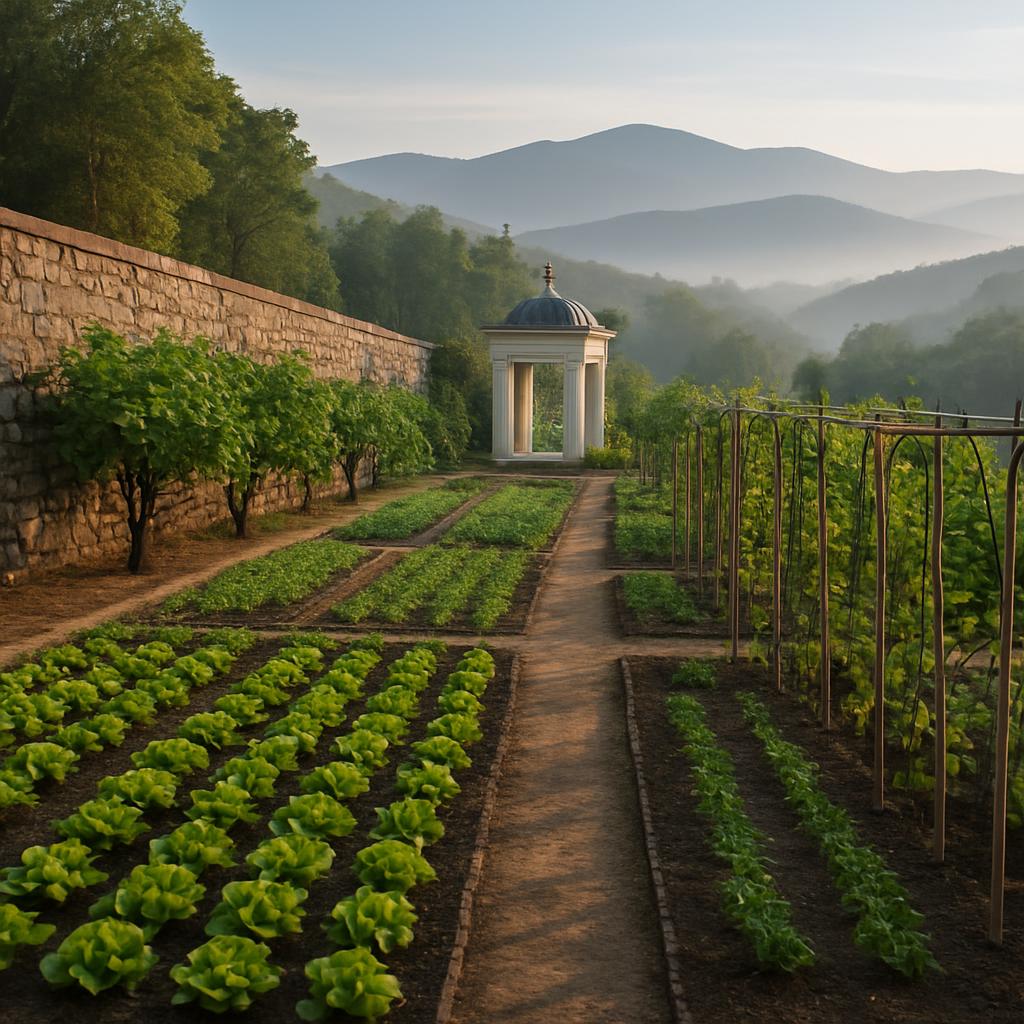
The Monticello vegetable garden is a 1,000-foot terrace cut into the hillside below Thomas Jefferson's house in Charlottesville, Virginia. Jefferson used it to trial hundreds of vegetable varieties, and a restored version of it is open to visitors today. This guide covers the garden's history, the enslaved people who built and worked it, how it was rebuilt, and which Jefferson crops you can grow at home.
Key takeaways
- Jefferson's terraced garden ran about 1,000 feet and was divided into 24 plots, grouped by the part of the plant you eat.
- Enslaved laborers dug the terrace and did most of the daily work, with Wormley Hughes serving as principal gardener.
- The terrace had vanished by the 1970s, and the vegetable garden was rebuilt from Jefferson's records and archaeology starting in 1979.
- 'Tennis Ball' lettuce, sesame, sea kale and the Marseilles fig are all documented Jefferson crops you can grow, though sesame and figs need warmth.
- Monticello's own shop sells seed, and several heirloom seed houses carry the same varieties.
What is the Monticello vegetable garden?
It is a terraced kitchen garden on the southeast slope of Jefferson's mountaintop, built into the hillside and held up by a stone retaining wall. Jefferson reserved the word "garden" for this space alone, and Encyclopedia Virginia calls it his chief horticultural achievement at Monticello. Crops had grown on this slope since the 1770s, and the long terrace took shape from about 1806 to 1809.
The terrace was laid out in 24 plots. Jefferson organized them by the part of the plant harvested: roots, leaves or fruits. A classical garden pavilion sits at the midpoint, built in 1812, and visitors in Jefferson's day described it as an observatory because of the long views over the Piedmont.
Around it sit the other pieces of the working landscape: the South Orchard and vineyards below the terrace, berry plantings, and the oval flower borders near the house. Fruit trees included peaches, apples, cherries and figs. The flower borders were Jefferson's family project, planted and tended largely by his daughters and granddaughters with the help of enslaved gardeners. The vegetable terrace was the part he supervised himself.
Why did Jefferson treat the garden as an experiment station?
He used it to find out which plants and varieties would perform well in Virginia soil and climate, and he recorded the results in his Garden Book. Over his lifetime he grew roughly 330 varieties. Sources count between 70 and 99 species of vegetables and herbs, depending on what is included. NPR described the garden as a living laboratory for a lifelong tinkerer and obsessive record keeper.
The trials were practical. He sowed lettuce and radishes every two weeks through the season so there was always something fresh. He put different varieties of the same crop side by side to compare them. He tested exotics such as sesame, chickpeas, salsify and sea kale. He also looked for crops that could replace expensive imports, which is why sesame oil appears in his notebooks as a stand-in for olive oil.
Seed exchange was part of the method. Jefferson swapped seed with friends, nurserymen and correspondents. Salsify reached him from Meriwether Lewis, and sesame came from New York. Not everything worked. His notes are full of sowings and harvests and the occasional failure, and he tried and dropped crops freely. The garden's value was the record as much as the vegetables.
Who built and worked the gardens at Monticello?
Enslaved African Americans did the great majority of the labor, from moving earth to hauling manure to sowing seed. Encyclopedia Virginia records that Jefferson hired seven enslaved men from a Fredericksburg farmer to move about 200,000 cubic feet of earth with a mule and cart, under overseer Edmund Bacon. A 12-foot stone wall at the tallest point held the terrace in place, and the work took about three years.
Wormley Hughes, born at Monticello in 1781, became the principal gardener. Monticello's biography of Hughes says he was probably trained by the Scottish gardener Robert Bailey. Jefferson's records show him planting seeds, bulbs and trees sent from Washington, preparing the flower beds, and spreading manure on the vegetable garden. Other enslaved gardeners, including George Granger Sr., kept the vegetable garden going while Jefferson was in Washington, working with his daughter Martha.
Enslaved families also kept their own plots, and their crops shaped what grew on the mountain. Monticello notes that African-origin crops such as okra, watermelon, gherkins and sesame were tended by Hughes and others. Jefferson's household depended on that produce to supplement the main table. After Jefferson died in 1826, most of the enslaved people at Monticello were sold in 1827 to settle the estate's debts, including Hughes's wife and children.
How were the Monticello gardens restored?
The flower gardens were restored first, in the 1930s. The vegetable garden followed from the late 1970s, after the original terrace had effectively disappeared. After Jefferson's death the grounds declined. By the 20th century the retaining wall was gone and erosion had returned the terrace to grassy hillside. When Peter Hatch arrived as gardens director in 1977, NPR notes, about 40 percent of the site was a tourist parking lot.
Restoration relied on Jefferson's own paper trail and on excavation. His 1807 garden plan, Garden Book entries and letters supplied the layout, and archaeology confirmed the location of the terrace and wall. Landscape architect Rudy Favretti detailed the wall reconstruction, and Hatch directed the planting and plant collecting. The garden today interprets the years around 1807 to 1814.
| Date | What happened |
|---|---|
| 1770s | Vegetable beds are cultivated on the southeast slope |
| c. 1806–1809 | The 1,000-foot terrace is excavated and walled |
| 1812 | Garden pavilion built at the midpoint |
| 1826–1827 | Jefferson dies; most enslaved people at Monticello are sold |
| 1939–1941 | Garden Club of Virginia restores the flower gardens |
| 1977 | Hatch arrives; terrace and wall are gone |
| 1979 onward | Vegetable garden, wall and orchards rebuilt |
| 1994 | Terrace, orchards, vineyards and berry patches fully complete |
| Today | Monticello is a UNESCO World Heritage Site, listed in 1987 |
Hatch went on to rebuild the plant collection itself. That work led to the Thomas Jefferson Center for Historic Plants at neighboring Tufton Farm, which collects, preserves and distributes historic and native varieties. That seed-saving role is why the garden functions as a seed bank as well as a museum.
Which Jefferson heirlooms are worth growing?
Four stand out for being well documented and genuinely rewarding: 'Tennis Ball' lettuce, sesame, sea kale and the Marseilles fig. They differ a lot in difficulty, so match the choice to your climate and patience.
'Tennis Ball' lettuce is the easy entry point. Monticello describes it as a Jefferson favorite, a black-seeded butterhead with pale-green leaves and a loose head, first documented in plantings at Monticello in 1809. Jefferson noted that it did not demand as much care as other types. It is considered a parent of modern Boston lettuces. Seed sellers list heads of 6 to 8 inches and maturity in 45 to 50 days.
Sesame (benne) was Jefferson's attempt at home-grown salad oil. Monticello's Twinleaf journal says he sowed it every year from 1809 to 1824 and bought or built three oil presses. Pressing proved laborious, so home growers are better off growing sesame as an ornamental and a source of seed for baking. It needs a long, hot season, so gardeners in cooler regions should start it indoors and set it out after frost.
Sea kale (Crambe maritima) is a perennial cabbage relative grown for its spring shoots. Monticello's entry lists hardiness zones 3 to 8, says Jefferson first recorded sowing it in 1809, and says established plants of 2 to 3 years produce the shoots. The shoots are blanched under pots to cut the bitterness and cut at about six inches, then cooked like asparagus. This is a long-term plant: expect to wait for your first real harvest.
The Marseilles fig is the fruit tree most tied to Jefferson's enthusiasm. Monticello's encyclopedia calls it a half-hardy, deciduous shrub with small, greenish-white fruit in late summer, and shows Jefferson sharing cuttings with friends. At Monticello, figs grew in warm beds along the stone wall. Farther north, grow figs in a large container that can come into an unheated garage for winter, or plant against a south-facing wall.
Where can you buy Monticello heirloom seeds today?
Start with Monticello's own shop, which sells seed from the Thomas Jefferson Center for Historic Plants. Its vegetable and herb seed page lists Tennis Ball lettuce, Alpine strawberry and Texas Bird pepper, and the shop also sorts seed into warm-weather and cool-weather collections. The Tennis Ball packet holds roughly 100 to 150 seeds, and Monticello's listing tags it as documented by Jefferson. Sales support the plant collection.
Independent heirloom seed companies also carry Tennis Ball lettuce, usually in larger packets. Diane's Seeds, Annie's Heirloom Seeds, R.H. Shumway's and Thresh Seed Co. all list it, each noting the Jefferson connection. Sea kale seed and sesame are available from specialty heirloom and herb suppliers. Check the packet for the variety name and whether it is open-pollinated, so you can save seed.
For the Marseilles fig, look to specialty fig and fruit-tree nurseries or fig-collector exchanges rather than seed. Figs are grown from cuttings or rooted plants, and names get tangled among nurseries, so ask a supplier to confirm the exact variety before buying.
How do you plant a Jefferson-style heirloom bed at home?
Copy his method rather than his scale: small plots grouped by harvest type, staggered sowings, and notes on everything. A bed of roughly 4 by 12 feet is enough for four or five of his crops.
- Pick a sunny, well-drained spot, ideally sloping gently south. Jefferson's terrace faced southeast, and the sun-warmed wall made a microclimate for figs.
- Divide the bed into plots by harvest: leaves (lettuce, orach, endive), roots (radishes, carrots, salsify), and fruits (tomatoes, peppers, okra, beans).
- Sow lettuce and radishes thinly as soon as the soil can be worked, then repeat every two to three weeks. Seed packets suggest covering Tennis Ball seed with only 1/8 to 1/4 inch of soil and thinning to 8 to 10 inches.
- Put heat lovers (sesame, okra, tomatoes) in after frost, in the warmest corner. Jefferson even bordered his tomato square with sesame or okra.
- Give sea kale its own permanent spot at the edge of the bed and cover the crowns with a bucket or pot in early spring to blanch the shoots.
- Keep a garden notebook with sowing dates, varieties and results. For lettuce, let a few plants bolt and save the seed after flowering; with Tennis Ball, keep other lettuce varieties apart to prevent crossing.
Jefferson sowed Brown Dutch lettuce in fall to carry through winter, so a late-summer sowing of Tennis Ball is also worth trying where winters are mild. If you want more crops for a first-year garden, our guide to the most popular vegetables to grow at home covers the basics, and the story of the White House kitchen garden shows how presidential plots have continued Jefferson's example.
How do you visit the gardens at Monticello?
Buy a grounds ticket or any house-tour ticket, and you can walk the terrace, orchards and flower borders. Monticello's itinerary page lists the grounds-only ticket at $22, free for members. Prices change, so confirm on the official site before you go. The grounds ticket does not include the house interior.
A free 45-minute Gardens and Grounds Tour is included with admission. The 2026 schedule ran March 28 through October 31, weather permitting, at 11 a.m., 1 p.m. and 2 p.m. from the fishpond, with no reservation needed. That season has closed, so check the dates for the next one. The tour covers Jefferson's designs and the free and enslaved people who built and maintained the gardens.
The vegetable garden is at its fullest from late spring through early fall. One travel guide recommends late August into September for lighter crowds with the garden still producing, and notes April is the busiest month. Allow at least three hours if you want the house, Mulberry Row and the gardens. Plan a seed-shop stop before you leave.
Frequently asked questions
How big is the Monticello vegetable garden?
The terrace is about 1,000 feet long and was divided into 24 plots in Jefferson's design. Width figures vary between sources, so cite length rather than acreage. The garden as interpreted today represents the years from 1807 through 1814.
What vegetables did Jefferson grow at Monticello?
He grew more than 300 varieties, including lettuce, peas, tomatoes, okra, sesame, sea kale, salsify, chickpeas, artichokes, cardoons and many beans. Peas were a favorite, and the first sowing in the new terrace in 1809 went in on March 23.
Is Tennis Ball lettuce hard to grow?
No. It is a compact butterhead that matures in about 45 to 50 days and prefers cool weather, so sow in early spring or late summer. Heat makes it bolt, so sow it every few weeks and harvest before summer.
Can I grow sea kale and Marseilles figs outside the South?
Sea kale is rated for zones 3 to 8 at Monticello, so it is hardy across most of the country, though it needs patience to establish. The Marseilles fig is half-hardy; in colder zones, grow it in a container and protect it over winter.
Do I need to take the house tour to see the gardens?
No. Monticello sells a Gardens and Grounds ticket daily, which includes the vegetable garden, flower borders, Mulberry Row and the seasonal gardens tour. The house interior requires a separate tour ticket.