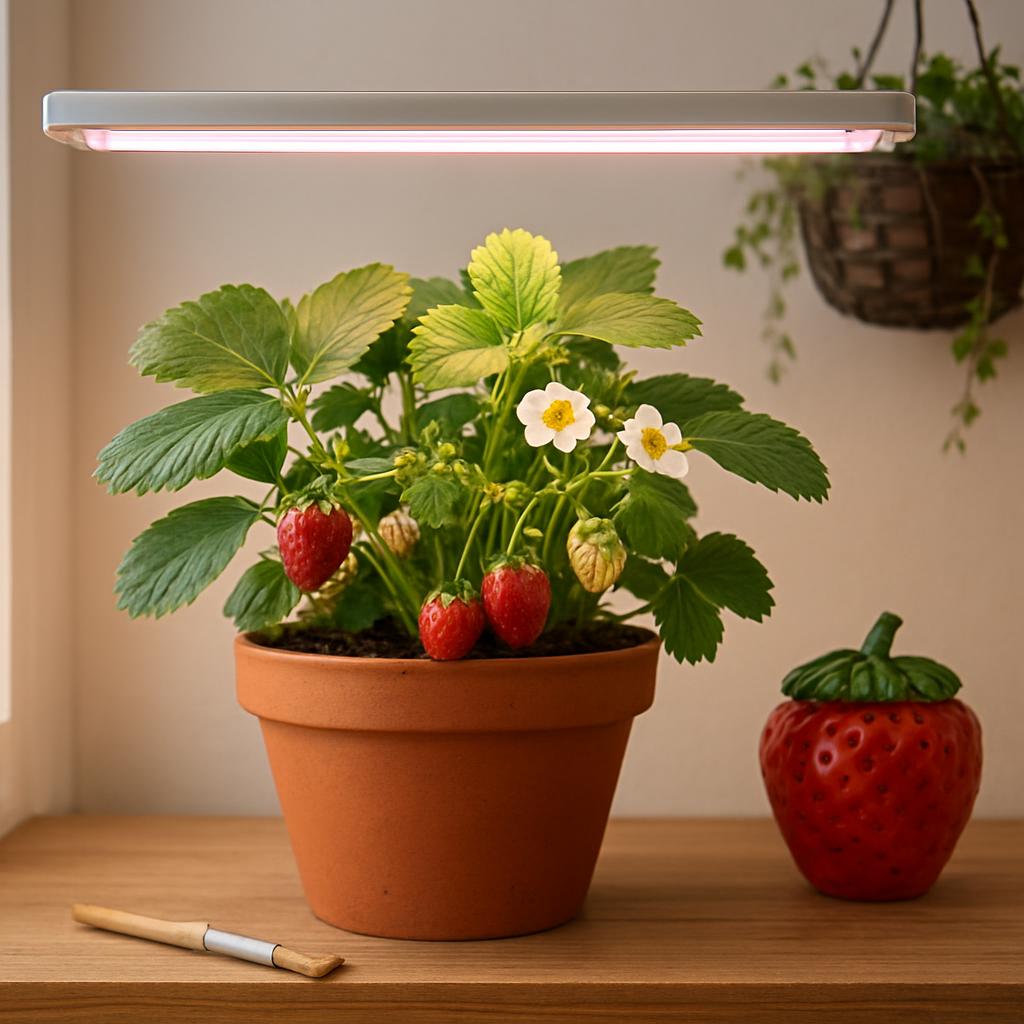
To grow strawberries indoors, plant a day-neutral, everbearing or alpine variety in a container with drainage holes. Give it bright light for 14 to 16 hours a day, and pollinate the flowers by hand with a soft brush. A sunny south window can work in summer, but a full-spectrum LED on a timer is what keeps plants fruiting through winter.
Key takeaways
- Choose day-neutral, everbearing or alpine strawberries, because June-bearers depend on seasonal cues a living room cannot supply.
- Any container works if it has drainage holes and holds at least 6 to 8 inches of a loose, fast-draining mix.
- Plan on 14 to 16 hours of strong, full-spectrum light for fruiting plants, and treat a window as a supplement in winter.
- Indoor flowers get no help from bees, so brush every open blossom every day or two.
- Water at the base, keep air moving, and check leaf undersides weekly for spider mites.
Which strawberries grow well indoors?
Day-neutral, everbearing and alpine strawberries do best indoors, because they flower without needing the short days and winter chill that outdoor plants get. Day-neutral types flower and fruit regardless of day length, which is why growers pick them for containers and controlled-light setups. Popular day-neutral cultivars include 'Albion', 'Seascape', 'Tristar', 'Tribute' and 'San Andreas', and Homes & Gardens notes they can give several crops across the year.
Everbearing types are a reasonable second choice. Modern everbearers are sold as day-neutral, but the SARE everbearing strawberry guide points out that other plant processes still respond to day length, so they tend to fruit in flushes rather than continuously. In a bright, warm room you will still get more than one crop.
Alpine strawberries (Fragaria vesca) suit small spaces. The berries are small and soft, but the flavor is strong and wild, and the plants stay compact. They rarely send out runners, which keeps shelves and windowsills tidy. Varieties such as 'Alexandria' and 'Mignonette' are commonly sold for pots. They also tolerate imperfect pollination better than large-fruited types, so they are a forgiving first plant.
Start with bare-root crowns, nursery plugs or plants from a garden center. Plugs started under lights typically reach first harvest in roughly two to three months. Seed-grown alpines take longer, but the packets are cheap and the plants are small.
Why do June-bearing strawberries struggle indoors?
June-bearers struggle indoors because they set flower buds in response to shortening days in fall and then need a cold, dormant period before they will crop. They are short-day plants and produce one concentrated harvest, which makes them a poor fit for a heated room with constant light and temperature.
The chilling requirement is the bigger obstacle. University of Maryland Extension lists strawberries at roughly 200 to 300 hours of cold, counted between 32 and 45°F, and requirements vary by cultivar. A plant kept at room temperature all winter never gets that rest. It produces leaves and runners, but few flowers.
It is possible to imitate winter by moving a pot into an unheated garage or refrigerator for several weeks, then back under lights. That is a lot of effort for one flush of berries, and the plants take up a lot of room. If you already own a June-bearer, treat it as an outdoor pot plant and bring it in only to protect it from hard freezes.
What is the best container for indoor strawberries?
The best container is any pot, basket or planter with drainage holes that holds at least 6 to 8 inches of soil depth and has room for the crown to sit level with the surface. Strawberry roots are shallow, so width matters more than depth. A single plant does well in an 8 to 12 inch pot, and an 18 to 24 inch bowl will hold about three.
Several designs are made for strawberries, and each has trade-offs:
- Standard pots: Easiest to water evenly and easiest to repot. Terracotta breathes and dries faster, which protects against overwatering but means more frequent watering. Plastic holds moisture longer.
- Strawberry jars (pockets on the sides): Compact and decorative, but the top of the jar soaks while lower pockets stay dry. Run a perforated tube or a rolled length of wire mesh filled with gravel down the center, and water through it so the moisture reaches every level.
- Hanging baskets: Good for trailing varieties and for freeing counter space under a light. They dry out fastest, so check them often, and use a saucer or drip tray so they don't leak on floors.
- Towers and stacked planters: The best use of a small footprint, especially under a vertical light. They need steady watering and care to keep lower tiers from shading each other.
Whatever you choose, avoid leaving a pot sitting in a saucer of water. Tip excess away after 15 minutes. Growing several small pots instead of one large container also limits the damage if pests or mold take hold, since you can isolate one plant.
What soil mix and drainage do strawberries need in pots?
Use a loose, fast-draining potting mix that stays slightly acidic, with a pH of about 6.0 to 6.8. A peat- or coir-based soilless mix blended with compost and perlite gives the combination of moisture retention and air space that strawberry roots want. Garden soil compacts in a pot and holds too much water.
Skip the common advice to put a layer of gravel at the bottom of the container. It does not improve drainage and can raise the wet zone closer to the roots. Drainage holes and a coarse, airy mix do the work. Fill the pot to about an inch or two below the rim so water has room to soak in, and set the crown at soil level with roots spread out. Burying the crown invites rot, and leaving it high dries it out.
Strawberries are susceptible to rot in cool, soggy conditions, which is why a container with a good mix is often a better setup than a heavy garden bed. If a pot stays wet more than a day or two, repot into a coarser mix or a pot with more holes.
How much light do indoor strawberries need?
Fruiting strawberries need roughly 14 to 16 hours of strong light a day indoors. Sources agree on a 6 to 8 hour minimum of direct sun from a south-facing window, but also that most homes in winter cannot deliver enough, so lights are what keep plants flowering and fruiting. Day-neutral plants kept at a shorter photoperiod flower less and make smaller fruit, so a timer set to 14 to 16 hours is worth the few dollars.
Growing strawberries under a grow light is simple in principle. Use a full-spectrum LED, since fruit needs far more intensity than lettuce or herbs, and a weak fixture left on longer will not make up for a dim one. Choose a fixture rated for flowering or fruiting plants, and read the manufacturer's guidance for hanging height. Raise it as the plants grow so leaves are close but never scorched.
Placement matters as much as wattage. Keep the light directly above the canopy, not off to one side, and rotate pots weekly for even growth. A shelf unit with a bar light or panel over each tier works well for several pots. For towers and hanging baskets, use a light that can reach the lowest plants without leaving the top in glare.
The table below sums up the setup.
| Factor | Target for day-neutral and everbearing plants |
|---|---|
| Daily light | 14 to 16 hours on a timer, with 8 or more hours of darkness |
| Light type | Full-spectrum LED, strong enough for fruiting crops |
| Position | Directly above the canopy, raised as plants grow |
| Window use | Supplement only; south-facing is best |
| Room temperature | About 60 to 75°F, avoiding heat in the mid-80s |
Temperature affects flowering too. Day-neutral strawberries flower best in moderate temperatures and slow down in high heat, so keep lights from warming the canopy past the mid-70s if you can.
How do you hand-pollinate strawberries indoors?
Brush the center of every open flower with a small, soft paintbrush, a cotton swab or a makeup brush, moving pollen across the raised cluster in the middle. Without bees or wind, indoor strawberries get little pollination, and flowers that go unpollinated produce small, lumpy or no fruit. Garden.com's container guide calls hand-pollination essential for indoor growers.
- Wait until a flower is fully open, with white petals spread and yellow center visible.
- Dab the brush lightly around the whole center, covering every small pistil. Aim to touch the entire cluster so the berry fills out evenly.
- Move from flower to flower with the same brush, which spreads pollen between blossoms.
- Repeat every day or two while the plant is blooming.
A small fan on low also helps by moving air and shaking pollen loose. It has a second benefit: moving air reduces humidity around the leaves, which limits mold. Misshapen berries with bare patches usually mean the pollination was incomplete, and the fix is to be more thorough with the brush. Berries are generally ready to pick about four to six weeks after the flowers open.
How should you water and feed indoor strawberries?
Water when the top inch of soil feels dry, pour at the base of the plant until water drains from the bottom, and avoid wetting leaves and fruit. Pots dry out quickly under lights, but strawberries dislike constant sogginess, so check by touch rather than by a fixed schedule. Water in the morning where possible so the surface dries by evening, which reduces the damp conditions that gray mold prefers. Irregular watering can also lead to deformed berries.
Feeding is little and often. Mix a balanced fertilizer into the potting mix at a reduced rate at planting, or start liquid feed at half strength every two weeks while plants grow leaves. When flowers appear, switch to a fertilizer higher in potassium, such as a tomato formula. Too much nitrogen produces dense foliage and few berries, and the crowded leaves hold moisture that invites mold. Flush each pot with plain water once a month to wash out accumulated fertilizer salts, since there is no rain to do it.
Pinch off runners if you want bigger berries, since each runner draws energy from the crop. Day-neutral plants make fewer runners than June-bearers, so this is a light chore. Pick berries as soon as they are fully red and remove any that rot, because ripe fruit left in humid air is the fastest route to gray mold. Plants lose vigor after a year or so of heavy fruiting, so take a few runners to root in small pots as replacements. If you are budgeting a first indoor harvest, a few plants and a light go a long way, a point we also make in our guide to growing a low-cost recession garden.
What pests and problems affect indoor strawberries?
Spider mites are the most common indoor pest, and they thrive in warm, dry air. Look for pale stippling on leaves and fine webbing, and check the undersides of leaves weekly with a hand lens. NC State Extension, in its spider mite scouting guidance, cautions that organically acceptable tools such as predatory mites and horticultural oils take longer to work and may need repeating.
Home growers can rinse leaves with water, apply insecticidal soap or neem oil according to the label, and release predatory mites (Phytoseiulus persimilis), which establish best in warm rooms above about 68°F. Wash the fruit before eating, and stop spraying well before harvest.
Other problems include:
- Aphids: Clusters of small insects on new growth and flower stems. Rinse them off early, then repeat treatments.
- Fungus gnats: Tiny flies from constantly wet soil. Let the top inch dry between waterings and use yellow sticky traps.
- Gray mold (Botrytis): Fuzzy gray rot on flowers and fruit. Improve airflow, water the soil not the leaves, space plants, and remove affected fruit at once.
- Powdery mildew: White film on leaves in humid, stagnant air. Add a fan and cut back on overhead moisture.
Inspect any new plant before bringing it near the others, and keep the growing area clean of fallen leaves and rotten berries. Most indoor pest problems begin with a nursery plant or with stale air. Other plants may benefit from the same habits, and if you are choosing what else to grow at home, our list of the most popular vegetables to grow at home is a good next step.
Frequently asked questions
Can you grow strawberries indoors without a grow light?
Yes, in a bright south-facing window in spring and summer, where plants can get 6 to 8 hours of direct sun. In winter the light is usually too weak and short, so growth slows and fruit is sparse. An LED on a timer fixes that.
How long do indoor strawberries take to fruit?
Plants started from plugs or crowns usually flower within weeks, and berries ripen about four to six weeks after the flowers open. Plan on roughly two to three months from planting to first harvest. Seed-grown plants take longer.
Can I grow strawberries from the seeds on a store-bought berry?
You can, but the plants often differ from the parent fruit because many commercial strawberries are hybrids. Germination is slow, and the plants take longer to fruit. Buying plugs or crowns of a named day-neutral variety is faster and more reliable.
Why are my indoor strawberry plants flowering but not making fruit?
The usual cause is missed pollination, since there are no bees indoors. Brush each open flower every day or two. Low light, or heat well above the mid-80s, can also stop fruit set.
Do indoor strawberries come back every year?
Strawberries are perennials, but indoor plants fruit hard and lose productivity after a year or so. Root a few runners as replacements. Alpine types rarely make runners, so they are best renewed by dividing the plant or starting new ones from seed.