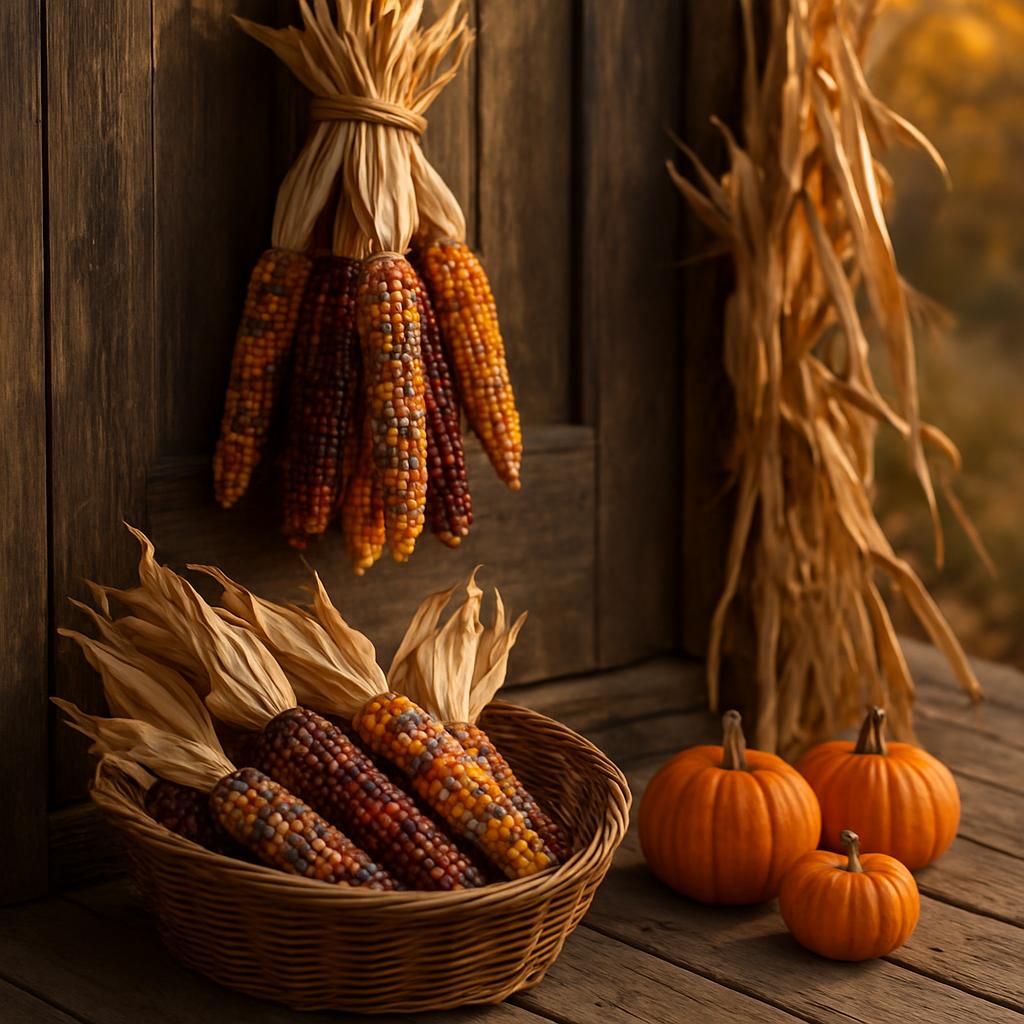
To grow Indian corn, sow flint or ornamental varieties in full sun once the soil reaches about 60°F, plant them in blocks at least four rows wide so the wind can pollinate the ears, and leave the ears on the stalk until the husks dry. The growing is the same as for any field corn. The differences are a longer season, strict separation from sweet corn, and a slow drying process before the ears go on a door or into a grain mill. This guide covers varieties, planting, care, harvest, drying, fall decorating and grinding.
Key takeaways
- Indian corn is flint or flour corn grown for hard, colorful kernels. It is not eaten off the cob like sweet corn.
- Plant after frost when soil is at least 60°F, in a block of four or more rows rather than one long row.
- Keep ornamental corn at least 250 feet from sweet corn, or stagger planting so tasseling is at least 14 days apart.
- Harvest after the husks have dried and lost their green, then finish drying the ears in an airy, rodent-proof spot.
- Dried ears can be used for fall decor for a season or two, or the kernels can be ground into cornmeal if you started with untreated seed.
What is Indian corn, and how is it different from sweet corn?
Indian corn is the common name for flint and other hard-kernel corns grown for color and for dry grain, and it is also sold as ornamental corn or calico corn. Native American farmers developed these corns over centuries, and many popular modern varieties trace back to those seed lines. Sweet corn is harvested while the kernels are soft and sugary. Indian corn is left on the plant until the kernels are fully dry and hard.
Flint corn gets its name from a hard, glassy outer layer on the kernel that is smooth and shiny, and it holds its color well after drying. Flour corn has a softer starchy interior and grinds more easily. Popcorn, dent corn and ornamental hybrids fall under the same Indian corn label at garden centers, so a bundle of mixed ears may include several types. For growing purposes you can treat them all alike: they are warm-season grasses that need a long, frost-free season.
The plants are larger than most sweet corn, and ears are usually 6 to 10 inches long. Expect stalks from about 4 feet for the earliest types to 8 to 10 feet for the giants. The trade-off is that the harvest is not a meal in the usual sense. You get a decorative crop and a pantry grain.
Which Indian corn varieties are worth growing?
Glass Gem and Painted Mountain are the two best-known choices, and Wade's Giant is a good option where summers are long. Pick by season length first and color second, because a variety that does not dry down before frost gives dull, soft ears.
Glass Gem was bred by Cherokee seedsman Carl Barnes from a mixture of Native American corns, and it produces translucent kernels in nearly every color. Seed sellers list it at roughly 105 to 120 days to maturity, so gardeners in cooler regions need an early start. It can be used as a decoration, and several sellers say it can be ground into meal.
Painted Mountain was developed over decades in Montana by Dave Christensen from a gene pool of about 80 native corns. It is technically a flour corn, but it is sold widely as ornamental corn. The plants are short, about 5 feet, and the ears are long and thin. It is the best pick for short summers or high elevations, with listed maturity between 70 and 90 days depending on the seller and climate.
Wade's Giant Indian Flint takes about 110 days and typically reaches 8 to 10 feet, so it needs space and is not suited to containers.
| Variety | Type | Typical days to maturity | Plant height |
|---|---|---|---|
| Glass Gem | Flint-type, multicolor | 105 to 120 | 6 to 9 ft |
| Painted Mountain | Flour corn, multicolor | 70 to 90 | 4 to 5 ft |
| Wade's Giant Indian Flint | Flint | About 110 | 8 to 10 ft |
| Hopi Blue | Flint, blue to purple | Varies by seed source | Varies |
Days to maturity vary between seed companies, as the table shows. Treat them as a comparison between varieties rather than a promise, and add a couple of weeks if your summers run cool.
When and how do you plant Indian corn?
Plant Indian corn after the last frost, when soil has warmed to at least 60°F, and sow seeds directly in the ground. Corn seed rots in cold, wet soil, and these varieties need every day of the season, so use a soil thermometer rather than the calendar. Several seed companies recommend 65 to 70°F for the most dependable stand, and black plastic laid over the bed a week or two ahead can warm cold soil.
Choose a spot with at least six hours of direct sun, preferably eight, and well-drained, fertile soil. Corn is a heavy feeder, so work in compost before planting and avoid fresh manure, which pushes leafy growth. A pH around 5.8 to 7.0 suits it.
- Loosen the bed and mix in finished compost.
- Sow seeds 1 to 2 inches deep (Painted Mountain can be shallower, about 3/4 to 1 inch), roughly 4 to 6 inches apart in rows 30 inches apart.
- Water thoroughly after sowing. Seedlings usually emerge in 7 to 10 days.
- Thin to 8 to 12 inches apart when seedlings are a few inches tall. Painted Mountain can go closer, about 6 to 7 inches.
- Mulch with straw or grass clippings once seedlings are up to hold moisture and suppress weeds.
Plant in a block of at least four rows, not a single long row. Corn is pollinated by wind, with pollen falling from the tassels onto the silks of each ear. In a thin row most of that pollen blows away, and the ears come out with gaps and missing kernels. A block of four rows, about 8 feet on each side, is the practical minimum, and a bigger block is better. Succession planting works for sweet corn, but for ornamental corn it mostly adds the risk of late plantings not drying before frost.
How do you keep Indian corn from cross-pollinating with sweet corn?
Separate ornamental corn from sweet corn by at least 250 feet, or time the plantings so they do not tassel together. All corn types are the same species and cross freely. Iowa State University Extension recommends isolating ornamental corn from sweet and field corn by 250 feet, or staggering planting so tasseling is separated by at least 14 days.
The damage runs mostly one way, and it matters most for the sweet corn. Purdue Extension says sweet corn must be isolated from field corn, popcorn and ornamental corn because their pollen turns sweet kernels starchy. Purdue notes that 250 feet allows some contamination that does not materially affect quality, and that 700 feet gives complete isolation, which only breeders need.
In a small yard, you rarely have 250 feet. The workable fixes are timing and layout. Plant the sweet corn early and the ornamental corn at least two weeks later, or choose varieties with clearly different maturity dates. Put the two plantings on opposite sides of the garden, and avoid placing one directly upwind of the other. A solid fence or a hedge between them helps a little but does not replace distance.
Neighbors count too. A field of dent corn or a neighbor's sweet corn within a few hundred feet can pollinate your ears. In an ornamental patch, stray pollen shows up as odd yellow or white kernels on the current year's ears. This is a cosmetic issue for decor, but it matters if you want to save seed that breeds true. If you grow several colorful varieties together, expect them to mix, which is how varieties like Glass Gem came about.
How do you care for Indian corn while it grows?
Keep the soil evenly moist, feed once or twice, and control weeds until the stalks shade the ground. Corn needs steady water, especially from tasseling and silking through the weeks the kernels fill. An inch a week from rain or irrigation is a good baseline, and a deep soaking in dry spells is better than frequent light watering.
Side-dress with a nitrogen source, such as compost tea or a nitrogen fertilizer, when plants are about knee-high, and again as they approach tasseling in poor soil. Hill a little soil around the base of tall varieties, which anchors the stalks. Tall varieties like Wade's Giant can lean after summer storms, so a windbreak or a spot sheltered from the strongest wind helps.
Corn earworm and European corn borer are the main insect pests. Borers weaken stalks and ears, and earworms feed at the tip of the ear under the husk. Clean weed control, collecting crop debris at season's end, and rotating the planting spot each year all reduce the problem. Ears with some tip damage are still fine for decor.
Beans and squash grown among the corn are the traditional Three Sisters combination. Seed companies recommend it for flint corn, since the beans fix nitrogen and the squash shades out weeds. Wait until the corn is established before sowing beans so they do not overwhelm it. If you are deciding what else to add to the plot, the most popular vegetables to grow at home overlap well with a corn bed.
When is Indian corn ready to harvest?
Harvest Indian corn when the husks have dried and lost their green, and the stalks are mostly brown. In many regions this is late September to October, roughly 100 to 120 days after planting for typical varieties. Fully matured ears often droop downward on the stalk, and the stalks rustle in the wind.
Do not rush. Ears picked early have soft, wrinkled or dull kernels and are prone to mold when stored. For ornamental use, Baker Creek notes the husks should be dry and papery. For popping or grinding, the ears should dry as long as possible on the stalk. Test a kernel by pressing a fingernail into it. A mature kernel is hard and does not dent.
A light frost will not hurt ears that are already mature. If a cold, wet spell arrives before the ears are ready, cut the stalks and move them under cover rather than leaving the ears to soak. Wet weather at harvest is the main cause of moldy ears.
Cut or snap the ears off, leaving a short length of stem, which helps for hanging later. Wear gloves, because dry husks and stalk leaves are scratchy. Raccoons, squirrels, deer and birds go after ripening ears, so harvest promptly once they are ready.
How do you dry and husk Indian corn?
Peel back the husks, then hang or lay the ears in a dry, airy place for two to six weeks until the kernels are rock-hard. Kernels at harvest can hold roughly 25 to 35 percent moisture, which is far too wet for storage. Air drying is the most reliable method, and it needs good airflow around every ear.
For decor, you can leave the husks attached and peel them back and tie them into a bundle. For grinding, remove the husks entirely so air reaches the kernels. Either way, a loft, covered porch, garage with ventilation, or a spare room with a fan works. Avoid a barn or shed where mice can reach the ears, because rodents will chew through a whole crop. Do not stack the ears in a bucket or bag, where trapped moisture invites mold.
Keep ears away from damp basements and direct, hot sun. Spreading them on wire racks outside on sunny days and bringing them in before the evening dew works well in dry climates.
For seed or for cornmeal, the target is about 12 to 15 percent moisture. Under 12 percent suits seed saving, and around 13 to 14 percent suits grinding. A grain moisture meter gives a real reading. Without one, the kernels should be hard enough that they cannot be dented and do not feel cool or damp in a closed jar after a day.
After drying, shell the ears by twisting them with both hands, or by rubbing two ears together. Wear gloves for large batches, since kernels can blister hands.
How can you use Indian corn for fall decor?
Dried ears work in wreaths, door bundles, centerpieces, mantel displays and porch arrangements, and they pair naturally with pumpkins, gourds and cornstalks. They are also one of the easiest Halloween and harvest decorations, since they need no care once dry.
- Door and porch bundles: Tie three to five ears together by their husks with twine or ribbon and hang them from a nail or the door knocker. Add a few cornstalks at the porch corners.
- Wreaths: Wire or hot-glue small ears onto a grapevine or straw wreath form, and fill the gaps with husks, dried flowers and small gourds.
- Centerpieces and mantels: Lay ears in a wooden tray or low basket with pumpkins and candles. Glass Gem ears are striking enough to stand alone in a bowl.
- Husk crafts: Dried husks can be soaked briefly to soften, then shaped into dolls, garlands or place-card holders.
- Garland: Thread small ears onto a length of twine or wire for a mantel or banister.
Use ears that are fully dry before you display them, since damp ears mold and smell. Outdoors, keep ears under a porch roof, because rain and dew will dull the colors and encourage mold, and squirrels and birds will take ears left within easy reach. Indoors, ears can be kept for the season and often reused the next year if stored dry in a box or paper bag. Wipe off dust with a dry brush.
The seed packet's color is not a guarantee. Weather, pollination and ear maturity change how vivid the colors are, so choose your best ears for the centerpiece and use the rest for bundles. If you also like seasonal projects for the yard, our guide to heirloom crops from Monticello's gardens is a good place to find more historical varieties to try.
Can you grind Indian corn into cornmeal?
Yes, flint and flour corns can be ground into cornmeal, but only if the seed was untreated and the kernels are fully dry. Many ornamental seed packets are sold treated with fungicide, which is fine for planting but not for eating. Use corn grown from seed labeled untreated or food-grade, and do not grind decorations that have been sprayed with sealant, paint or craft finishes.
Flour corn such as Painted Mountain grinds easily and is sold for flour, cornbread and masa. Flint corn is harder and needs a sturdy grain mill with steel or stone burrs. Seed sellers describe Glass Gem as suitable for grits or cornmeal, although the colors blend into a muted tone once ground. Flint corn tends to give a coarser meal with a strong corn flavor, which suits polenta and grits.
Shell the ears, check that the kernels are hard and dry (about 13 to 14 percent moisture is a common target for grinding), and run them through a grain mill in small batches, adjusting from coarse to fine. Sift out the larger pieces and regrind them. Freshly ground meal contains the germ, so it goes rancid faster than store-bought degermed meal. Keep it in the refrigerator or freezer in a sealed container, and use it within a few weeks.
Whole dried kernels last for a year or more in sealed jars in a cool, dark place, which is a good reason to grind only what you need. For a vegetable plot that earns its keep, a patch of grain corn also fits a thrifty plan such as a recession garden, although a small block yields only a modest amount of meal.
Frequently asked questions
Can you plant the Indian corn you bought for decoration?
Sometimes. If the kernels are mature and were stored dry, many will germinate, and it costs little to try a few. Store-bought bundles are often mixed or hybrid ears, so the offspring may not match the colors you see, and some kernels may have been treated or sprayed.
Can you eat Indian corn?
Yes, but not like sweet corn. The kernels are starchy and hard, so they are dried and ground into cornmeal, grits or masa, or parched. Eat only corn grown from untreated seed, and not decorative ears that have been displayed or sprayed.
How much space does Indian corn need?
A block of at least four rows, about 8 feet on each side, is the minimum for good pollination. Rows 30 inches apart with plants 8 to 12 inches apart in the row are typical. Tall varieties such as Wade's Giant do not do well in containers.
Why are the ears on my Indian corn only partly filled?
Poor pollination is the usual cause, especially when the corn is planted in one row or in a very small patch. Drought or heat during silking and cool, wet weather can also leave gaps. Plant a wider block and water deeply from tasseling through grain fill.
How long do dried ears last as decorations?
Indoors and kept dry, ears typically last through the season and often into the next year. Outdoors they last a few weeks to a season, depending on rain and critters. Store them in a dry place in a ventilated box.