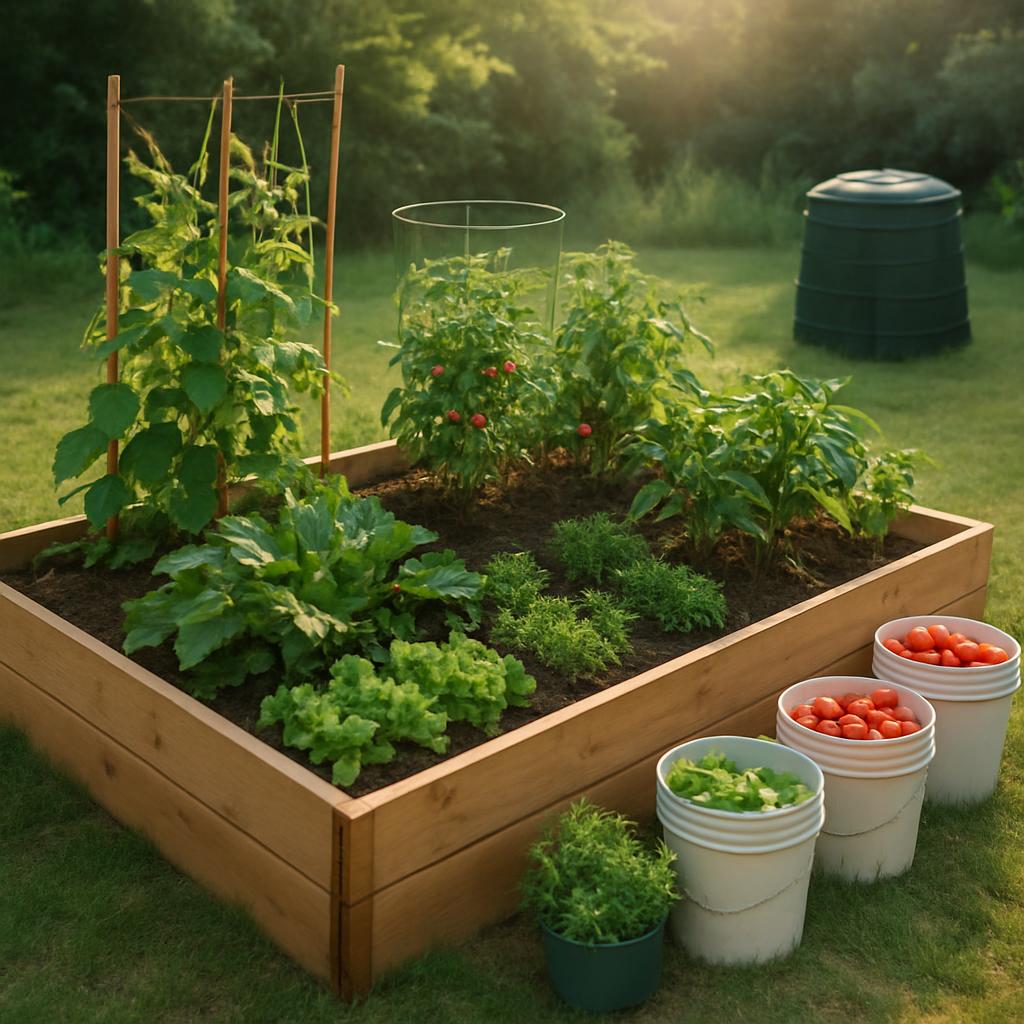
A recession garden is a low-cost vegetable garden planted to cut the grocery bill, using seeds, free containers and homemade compost and favoring crops that are expensive to buy and easy to grow. The idea is old, but it comes back whenever food prices climb or household budgets tighten. This guide covers what a food garden actually saves, which crops earn their space, how to start for very little, and a first-season plan for a 4x8 bed.
Key takeaways
- The biggest savings come from pricey, perishable crops like herbs, salad greens, cherry tomatoes and chile peppers, not from bulk staples like potatoes and onions.
- A typical home garden saves a few hundred dollars a year, and the first year is often close to break-even once you count soil, tools and mistakes.
- Seeds, homemade compost, salvaged containers and staggered sowings cut startup costs far more than any gadget.
- A 4x8 bed (32 square feet) planted with the right mix can supply salads, herbs and summer vegetables for a household.
- Preserve surplus tomatoes and beans by tested methods only, because canning errors are a food-safety problem, not a quality problem.
What is a recession garden?
A recession garden is a vegetable garden planted mainly to lower your food spending, and it differs from a hobby garden in how you choose crops and how little you spend setting it up.
The name goes back to the 2008-2009 downturn, when seed companies reported surges in sales and newspapers ran how-to pieces on starting a garden to stretch a shrinking paycheck. It follows the older tradition of wartime victory gardens, which framed home food growing as both thrift and civic duty. If you want that history in more detail, our piece on the White House kitchen garden and victory gardens covers how presidents and households used gardens in hard times.
The practical rules are simple. Grow what costs the most per pound at the store. Start from seed. Reuse containers and kitchen and yard waste. Plant small amounts often so nothing goes to waste. Then preserve what you cannot eat fresh.
Why does interest in recession gardens return when food prices rise?
Gardening interest rises when grocery receipts get noticeably bigger, because a garden is one of the few household costs you can shrink by your own labor.
Overall grocery inflation has cooled from its 2022 peak. USDA's Economic Research Service, in its Food Price Outlook, forecast food-at-home prices to rise 2.4 percent in 2026, a little under the 20-year average of 2.6 percent. Averages hide big swings, though. Reporting on the USDA's mid-year data noted that retail lettuce prices in June were 32.1 percent higher than a year earlier, with tomatoes up 19.5 percent.
That pattern is why a recession garden focuses on specific crops. Fresh produce is volatile, and the items that spike most, such as lettuce and tomatoes, are exactly the ones a backyard grows well. Rising prices are only part of the pull. Job worries, supply scares and a general wish for some control over the household budget all bring first-time gardeners back.
How much money does a home vegetable garden really save?
A well-run home garden typically saves a few hundred dollars a year, not thousands, and it rarely pays off fully in the first season.
The figure most often quoted is a National Gardening Association estimate, repeated by University of Missouri Extension, of about $500 a year in produce for a well-maintained garden. The same page cites a 2012 Oregon State University study that put the mean value of a home vegetable garden at $0.74 per square foot. On a 32-square-foot bed, that average works out to roughly $24, which shows how much the crop mix matters: the average includes many low-value plantings, and a bed built around herbs, greens and tomatoes can beat it comfortably.
Start-up costs are the honest catch. As University of Georgia horticulturist Timothy Coolong told Yahoo Life, you may not see big savings right away, though they add up over time. Lumber, bagged soil, fencing and tools can eat a first-year budget if you buy everything new. A frugal start, covered below, can keep first-year spending to seed money and a few salvaged materials.
Count your own costs too: water, a few hours a week, and the crops that fail. A pest outbreak or a hot spell that bolts the lettuce is a normal loss, not a sign you did it wrong. Treat the first season as tuition, and the second as the one that should show a real return.
Which vegetables save the most money per square foot?
Fresh herbs, salad greens, cherry tomatoes and chile peppers return the most dollars per square foot, with zucchini and pole beans close behind.
University of Maryland horticulturist Jon Traunfeld told Yahoo Life that leafy greens, lettuce, microgreens, garlic, herbs and chile peppers are especially pricey at the store, and growing them can reduce food bills. The table below converts typical yields and store prices into rough planning ranges. They are editorial estimates, not measured results, and your climate, variety and care will move them.
| Crop | Why it pays | Rough value per square foot per season |
|---|---|---|
| Herbs (basil, parsley, cilantro, chives) | Small store bunches cost $2 to $4 and wilt fast | $20 to $50 or more |
| Salad greens (cut-and-come-again) | Bagged mixes are costly and spoil in days; several sowings per season | $8 to $20 |
| Cherry and slicing tomatoes | Heavy, long harvest; store tomatoes are pricey and often bland | $6 to $15 |
| Chile and sweet peppers | Steady yield; hot and specialty types sell at a premium | $2 to $6 |
| Pole beans (on a trellis) | Vertical growing uses little ground and bears for weeks | $2 to $6 |
| Zucchini and summer squash | Highest weight per square foot, but one plant needs room | $3 to $6 |
| Potatoes, onions, storage cabbage | Cheap in bulk at the store | Under $2 |
Zucchini needs a caveat. It leads in pounds per square foot, but the pounds are cheap and a single plant can bury a household in July. Plant one or two, not six. Tomatoes carry the most total value for a beginner. Cherry types pay best, because they bear heavily and a pint at the store costs several dollars. For a broader look at what to plant, see our list of the most popular vegetables to grow at home.
How do you start a food garden for almost nothing?
You start cheaply by buying seed packets instead of plants, making your own compost, and using containers and materials you already have or can get free.
Seeds are the biggest single saver. A packet costs a few dollars and holds far more than one household needs, while transplants are priced per plant. Sow beans, zucchini, salad greens, cilantro and radishes directly in the bed. Tomatoes and peppers are worth starting indoors on a sunny windowsill, about six to eight weeks before your last spring frost for tomatoes and a couple of weeks earlier for peppers, which grow slowly. If indoor space is a problem, buy just three or four transplants of those two crops and sow everything else. Choose open-pollinated varieties of beans and tomatoes if you want to save your own seed for next year; hybrids will not come true.
Compost is the second saver. Pile kitchen scraps, coffee grounds, shredded leaves and grass clippings, mixing wet green material with dry brown material, and it turns into usable compost in a few months. Fall leaves alone make a good soil amendment and mulch. Many municipalities sell or give away finished compost, so check before you buy bags.
Containers cost nothing if you look around. Five-gallon buckets with drainage holes drilled in the bottom hold a tomato or pepper plant well. Wooden crates, old tubs and sturdy plastic totes work too, provided they never held chemicals or anything toxic. For a raised-bed alternative with minimal lumber, straw bale gardening turns a bale into a planting bed that needs no soil purchase.
How does succession planting stretch a small garden?
Succession planting means sowing small batches of fast crops every few weeks so you harvest steadily instead of all at once, and it is how a small bed produces like a larger one.
Maine Organic Farmers and Gardeners advises that for quick crops like lettuce, radishes and spinach, frequent small plantings, perhaps one every week or two, keep the harvest steady. Planting a whole radish crop at once, the author notes, leaves you with more than you can use and then none. Beans are slower, so sowing every three weeks or so through midsummer is a common rhythm.
Lettuce will not germinate well or hold up in summer heat, with gardeners typically pausing when temperatures stay above about 75°F. Resume in late summer for fall salads. A second kind of succession is replacing a finished crop with a new one in the same spot: pull the spent spring greens and sow beans or basil there.
What is a simple first-season plan for a 4x8 bed?
A 4x8 bed gives you 32 square feet, enough for a salad-and-sauce garden if you put tall crops on the north side and keep the quick crops where you pass every day.
The layout below assumes a sunny site with at least six hours of direct sun and is a starting plan, not a rule. Adjust spacing to your seed packets.
| Area | Crop | Planting method |
|---|---|---|
| North edge, 8 sq ft | Pole beans on a trellis | Sow seed after the last frost |
| 4 sq ft | Two cherry tomato plants, staked or caged | Start indoors or buy two transplants |
| 3 sq ft | Three pepper plants (one hot, two sweet) | Start indoors or buy transplants |
| 4 sq ft | One bush zucchini | Sow seed after frost |
| 4 sq ft | Basil, parsley, chives, cilantro | Sow in small blocks; resow cilantro |
| 9 sq ft, front of bed | Salad greens in three sections | Sow one section every two weeks |
Follow this order across the season:
- Two to three weeks before the last frost, sow the first section of lettuce and a block of cilantro and parsley, which tolerate cool weather.
- Start tomatoes and peppers indoors if you are growing from seed, and set them out once nights stay warm.
- After the last frost, sow beans at the trellis and zucchini in its corner, and plant the basil.
- Every two weeks, sow the next section of salad greens until summer heat arrives, then rest that area or shade it.
- Mulch the whole bed with straw or leaves to hold water and suppress weeds.
- When greens finish, replace them with a late bean sowing or leave the space for fall lettuce.
Pick and cook from it every day, because regular harvesting keeps beans, zucchini and herbs producing. Keep notes on what you actually ate. Next year, plant more of what you used and less of what you didn't.
How do you preserve the surplus so it doesn't go to waste?
Freeze, dry or can the surplus using tested methods, and be strict about tomato acidity, because home canning only works when the acid level and process time are right.
Tomatoes are the main preserving crop in this plan, and the National Center for Home Food Preservation says that to ensure safe acidity you should add two tablespoons of bottled lemon juice or half a teaspoon of citric acid per quart, with half those amounts for pints. Use bottled lemon juice, not fresh-squeezed, so the acidity is guaranteed. Follow a research-based recipe exactly; don't invent your own.
Plan around what is easy. Freeze whole cherry tomatoes on a tray, then bag them for winter sauce. Shred surplus zucchini into recipe-sized bags for baking and soups. Blanch and freeze pole beans. Green beans are a low-acid vegetable, so if you want to can them you need a pressure canner and a tested recipe; a boiling-water bath is not safe for them. Hang herbs to dry, or freeze chopped herbs in ice-cube trays with a little water or oil.
Preserving has its own costs, such as jars, lids and freezer space, so start with freezing, which needs only bags and a freezer you already own. A quart of your own sauce in January is where a tomato plant's value shows up again.
Which crops rarely pay for themselves?
Cheap bulk staples like potatoes, onions, carrots and cabbage rarely save money for a beginner, because they take space for a long season and are inexpensive at the store.
Corn is the classic space-waster. It needs a block of plants to pollinate and yields little per square foot. Winter squash and pumpkins sprawl across the whole bed. If you like growing them, treat them as a hobby crop and plant them when you have extra ground.
The same logic applies to fussy crops where your local climate works against you. If summers are too hot for lettuce or nights too cool for peppers, choose heat-tolerant greens like chard, or grow peppers in a dark container that warms up. A crop that fails every year saves nothing. Spend your first seasons on the dependable high-value crops, and expand once they are working.
Frequently asked questions
Is a recession garden actually worth it?
Yes, if you grow high-value crops and keep startup costs low, though the first season is often close to break-even. Savings usually run to a few hundred dollars a year for a small garden, with the best returns from herbs, greens and tomatoes.
How big should a beginner's recession garden be?
A 4x8 bed, or about 32 square feet, is a manageable first size. It holds a few tomato and pepper plants, a trellis of pole beans, a zucchini, herbs and a section of salad greens. Starting small lets you learn before spending more.
Can I do this in containers or on a balcony?
Yes. Herbs, salad greens, cherry tomatoes and peppers all grow in pots, with five-gallon buckets suiting tomatoes and peppers. Containers dry out faster than beds, so plan to water often in summer.
Is it cheaper to start from seed or buy plants?
Seed is cheaper per plant by a wide margin, and a packet usually covers several seasons of sowing. Transplants save time for slow crops like peppers and tomatoes, so a mix, with direct-sown beans, greens and zucchini, keeps costs down.
When should I start a recession garden?
Start planning about two months before your last spring frost. Cool-season greens and herbs can go in a few weeks before that frost, while beans, zucchini and basil wait until the weather is warm. If you are reading this in fall or winter, gather containers, build compost and order seed now.
Can I safely can my own tomatoes?
Yes, with a tested recipe and added acid. Use bottled lemon juice or citric acid in every jar, as the National Center for Home Food Preservation directs. Freezing is a simpler option if you are new to canning.