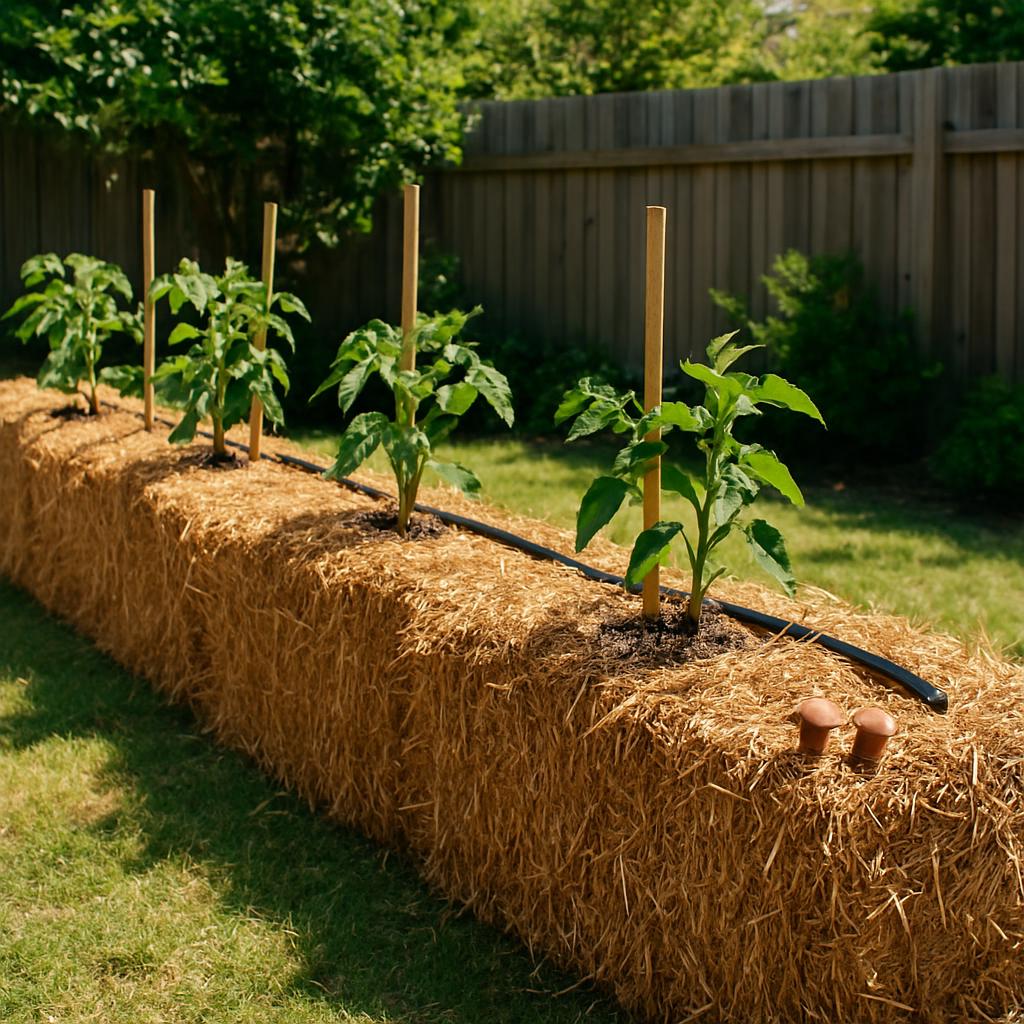
Straw bale gardening is a no-dig way of growing vegetables in the bale itself, which acts as both container and growing medium once it has been soaked and fed for 10 to 14 days. It works on bad soil, concrete, gravel or a back that no longer tolerates bending. It is also called hay bale gardening, although straw is the better material for most gardeners, and the difference is covered below.
Key takeaways
- Use straw, not hay, because hay brings weed seeds and often costs far more.
- Ask where the bales came from, since persistent herbicides in straw or hay can ruin tomatoes, beans and other broadleaf crops.
- Condition each bale for 10 to 14 days with water and nitrogen, and plant only after it has cooled.
- Tomatoes, peppers, cucumbers and squash do best, while corn, root crops and perennials do poorly.
- A bale lasts one season, then becomes compost, mulch or soil improver.
What is straw bale gardening and how does it work?
Straw bale gardening is container gardening in which the bale is the container. The tight outer crust holds the shape, and the straw inside is turned into a rooting medium by decomposition. As the bale breaks down, Virginia Cooperative Extension describes the straw as becoming "conditioned" and ready to plant.
Raw straw is mostly carbon and holds little nitrogen. Microbes that break it down pull nitrogen out of their surroundings, which starves seedlings set into a fresh bale. Conditioning feeds those microbes ahead of time so the bale heats up, burns through its initial burst of activity and cools before roots arrive.
The method suits gardeners with poor soil, a history of soilborne disease or nematodes, or no room to rotate crops. University of Illinois Extension notes that each bale is used for only one season, so a new bale each year acts as a fresh, disease-free bed. Because the bale sits above ground, it also warms earlier in spring and puts plants at a comfortable working height.
The tradeoffs are real. Bales need more frequent watering than in-ground beds, they need regular feeding, and they are a recurring cost. A bale garden suits a small, productive patch of fruiting vegetables better than a large staple-crop plot. For a wider view of what to grow at home, see the most popular home garden vegetables.
Straw or hay: which bale should you use?
Use straw. Straw is the dry, hollow stalk left after a grain crop such as wheat or oats is harvested. Hay is cut grass or legumes, dried and baled as livestock feed, so it still carries seed heads.
Many older guides and blog posts say "hay bale gardening" and mean the same method. Hay bales do work, and the University of Arizona's straw bale guide mentions that alfalfa hay works too. The cost is a bale that sprouts a lawn of grass and weeds, more nitrogen to break down, and more heat during conditioning.
| Straw | Hay | |
|---|---|---|
| What it is | Hollow stalks left after grain harvest | Cut grass or legumes dried for feed |
| Weed seeds | Few; stray grain may sprout | Many; the bale can turn into a weedy mat |
| Color and feel | Gold, dry, hollow stems | Green to gray-green, leafy, denser |
| Price | Usually cheaper | Usually higher |
| Decomposition | Slower, with less heat | Faster and hotter |
| Best use | First choice for bale gardens | Only if straw is unavailable and you accept weeding |
If hay is all you can get, expect to clip or pull sprouting grass through the first month. Some gardeners find that a thin sprouting layer is easy to cut back with scissors, but it competes with seedlings and makes direct seeding impractical. Wheat straw is the most commonly recommended type. Oat straw also works. The Arizona guide advises against barley straw because it might inhibit plant growth.
Where do you get bales, and how should you place them?
Buy bales from a farm supply store, feed store, co-op or directly from a grain farmer, and ask what was sprayed on the field. Persistent herbicides are the main hidden risk in this method. Garden Myths lists the culprits as pyridine-group growth regulators, including clopyralid, aminopyralid, aminocyclopyrachlor and picloram, which can stay on straw and in soil for years.
Tomatoes, beans, peas, potatoes and other broadleaf plants show the damage as stunted growth and twisted, curled new leaves. These herbicides can survive composting, so contaminated bales are not safe to compost. If a seller cannot say what was applied, a simple test helps: fill a pot with a mix of potting soil and straw from the bale, sow bean seeds, and watch for distorted growth in the seedlings before committing a whole garden.
Place the bales where they will get at least six hours of sun and within reach of a hose. Set them with the cut ends, where the straw stalks run vertically, facing up, so the twine runs along the sides. Illinois Extension recommends putting bales on their side with the twine facing outward, and putting tall crops on the north side so they do not shade smaller plants. Leave the twine on, because it holds the bale together as the straw softens.
Position bales in their final spot before wetting them, because a saturated bale is too heavy to shift. Set them end to end in a row, or in a block with a small gap for access. On grass or weeds, put down cardboard or landscape fabric first. A wet bale weighs many times what a dry one does, so a deck or balcony needs a structural check before you try this there.
How do you condition a straw bale?
Conditioning is a 10- to 14-day cycle of soaking, nitrogen feeding and cooling that starts decomposition inside the bale. Start about two weeks before your target planting date, which for tomatoes, peppers and other warm-season crops means around your last frost date.
Extension schedules differ in amounts, so pick one and follow it through rather than mixing recipes. The framework below follows the Illinois Extension timeline, with amounts based on urea (46-0-0).
| Days | What to do |
|---|---|
| 1-3 | Soak the bale until water runs from the bottom, and keep it wet |
| 4-6 | Sprinkle about 1/2 cup urea on top of each bale and water it in slowly so it soaks down rather than running off |
| 7-9 | Cut the nitrogen to about half, and keep watering |
| 10-11 | Stop nitrogen and keep the bale moist; some schedules add a balanced 10-10-10 fertilizer around now |
| 12 | Check the temperature; plant when the bale is cool to the touch |
Push your hand, or a compost thermometer, into the center. A bale is ready when the interior has dropped to about body temperature, under roughly 100°F. If it is still hot, keep watering and check again each day. Cold weather slows the process, so allow extra days in early spring.
Organic gardeners can use blood meal or another high-nitrogen amendment in place of urea. These release nitrogen more slowly, so allow extra days and follow the product label for the amount. Ammonium sulfate is also used, at a different rate than urea. Do not double doses to speed things up. Too much nitrogen can burn roots and leave excess salts in the bale.
How do you plant transplants and seeds in a bale?
Plant transplants by pulling the straw apart, making a pocket for the root ball and filling around it with potting mix. Keep the crown at the same depth it had in its pot. If cracks or voids open in the bale, fill them with loose straw or sterile potting mix. Avoid garden soil, which brings in weeds and soil pathogens.
Seeds need a seedbed, because they cannot germinate in coarse straw. Cover the top of the bale with a layer of potting mix or compost about one to two inches deep, keep it constantly moist, and sow lettuce, beans, radishes or herbs into it. The Arizona guide recommends pony-pack seedlings for planting directly into the bales and suggests covering them with loose straw for protection.
Transplants are the better choice for slow, long-season crops such as tomatoes and peppers. They get established while the bale is still releasing nitrogen, and they miss the delicate seedling stage when a bale is most likely to dry out.
- Confirm the bale has cooled to around body temperature.
- Water the bale well the day before planting.
- Open a planting hole in the top with a trowel and fill it with potting mix.
- Set the transplant at its original depth and firm the mix gently.
- Water slowly until water runs from the base.
- Add stakes or a trellis now, before roots fill the bale.
Which crops do best and worst in bales?
Heavy-feeding fruiting crops do best. Joel Karsten, the gardener who popularized the method, says tomatoes, peppers and cucumbers do really well and that the whole squash and cabbage families like bales. Lettuce, beans, herbs and strawberries also work well.
Suggested plant counts per bale, from Saferbrand's beginner guide, keep the bale from being overcrowded:
| Crop | Plants per bale |
|---|---|
| Tomatoes | 2 to 3 |
| Peppers | 4 |
| Squash | 2 to 4 |
| Zucchini | 2 to 3 |
| Cucumbers | 4 to 6 |
| Strawberries | 3 to 4 |
Avoid sweet corn, which is top-heavy and gives a tiny yield with a risk of toppling the bale. Root crops such as potatoes, carrots and turnips also do poorly in straw. Skip perennials like asparagus, artichokes and rhubarb, because the bale will not last more than two seasons. If you want ornamental or field corn, give it ground, as described in our guide to growing Indian corn.
Choose compact or determinate tomato varieties where possible, and trellis vines. Indeterminate tomatoes can outgrow the support a softening bale can give. Pole beans and cucumbers can be trained up a frame on the bale's north side.
How should you water and feed a bale garden?
Water daily in warm weather, and feed regularly, because straw holds neither moisture nor nutrients the way soil does. Dry bales are the most commonly reported problem in bale gardening, and the answer is simply more water, especially in midsummer heat.
The simplest approach is drip irrigation or a soaker hose laid along the top of the bale on a timer. Check by pushing a finger a few inches into the straw. If it feels dry, water again. Hand watering from above works, but it takes longer and wastes water running down the sides.
Feed lightly and often once plants are growing. A water-soluble vegetable fertilizer every one to two weeks suits fruiting crops, and Illinois Extension recommends continued feeding because straw does not supply nutrients as soil does. Nitrogen deficiency is the most common problem. Yellowing lower leaves early in the season usually mean the microbes are still using up nitrogen, and a nitrogen feed with steady watering corrects it. Once fruit sets, shift to a fertilizer with more potassium, and follow the label rate for the product you choose.
What problems come up: mushrooms, heat and collapsing bales?
Most problems come down to water, nitrogen or structure. A few are cosmetic.
- Mushrooms: Mushrooms are a sign of decomposition and are not harmful to plants. Knock them off or leave them and they will disappear. Never eat them, because wild mushrooms are difficult to identify and some are poisonous.
- Sprouting grass or grain: Stray grain seed sprouts in straw bales. Clip or pull it, and expect more from hay.
- Heat in the bale: A bale still hot from decomposition can scorch roots. Wait for it to cool before planting, and keep watering if the interior temperature stays high.
- Midsummer drying: The sides and top lose water quickly in strong sun. Mulch the top with loose straw and water more often.
- Collapse: The bale sags and loses shape as decomposition speeds up midseason. Add stakes or a trellis anchored beside the bale at planting time, since bales soften and shrink as they rot.
- Distorted leaves: Curled, stunted new growth on tomatoes, beans or potatoes suggests herbicide contamination rather than a nutrient problem.
If a bale has slumped, fill gaps with loose straw or potting mix and tie a stake or string to keep the plant upright. If plants show herbicide damage, stop adding to the bale, and do not move the straw into compost or beds. Remove the plants and use a different, verified source next season.
For anything that goes wrong, keep notes for the next season: date conditioned, fertilizer used, planting date and variety. Those records show what worked, and a bale garden is cheap enough to adjust each year. If budget is the reason you are trying bales, our recession garden guide covers other low-cost options.
What do you do with spent bales?
Treat a spent bale as a half-composted heap of organic matter. By the end of the season it is a soft, dark mass that is ready to go on the compost pile or garden beds. It will not carry through a second season well, as Illinois Extension says each bale is for one season.
Pull out the plant roots, then chop or break up the bale. Add it to a compost pile in layers with greens, use it as mulch around shrubs and perennials, or dig it into beds as soil improver. A bale left in place through winter often grows a flush of fungus and breaks down on its own.
Only reuse or compost bales if you are sure they are free of persistent herbicides. If a bale showed damage to plants, keep it out of compost and vegetable beds. Because those chemicals survive composting, a contaminated bale can carry the problem into every bed it reaches.
Some gardeners reuse a bale for a second season, replanting with undemanding crops or flowers after re-feeding. Results are uneven because the straw has already broken down. A fresh bale is more reliable for tomatoes and other heavy feeders.
Frequently asked questions
Can you use hay bales for a vegetable garden?
Yes, but straw is the better choice. Hay contains seeds, so a hay bale grows grass and weeds along with your vegetables. Hay also costs more and decomposes faster and hotter. Use it only if straw is unavailable, and expect to weed.
How long does it take to condition a straw bale?
Plan on 10 to 14 days. Illinois Extension lists about 12 days, with three days of watering followed by days of nitrogen feeding, and you should plant only after the bale cools. Cold weather and organic fertilizers can add a few days.
Do I need to remove the twine from the bales?
No. Leave the twine or wire in place, since it holds the bale together as the straw softens. Set the bale so the strings run along the sides rather than across the top and bottom.
Are mushrooms on my straw bale a problem?
No. They show that the straw is decomposing, and they do not harm plants. You can knock them off or leave them. Do not eat them.
Can I grow potatoes or carrots in a straw bale?
Results are poor. Root crops such as potatoes, carrots and turnips do not grow well in bales, and sweet corn is too top-heavy. Put these in the ground or in deep containers and save the bales for tomatoes, peppers, squash and cucumbers.
How many bales do I need?
Count plants, not square footage. Tomatoes need one bale for every two or three plants, while cucumbers fit four to six per bale. Start with two or three bales in your first season.